Category

Blog

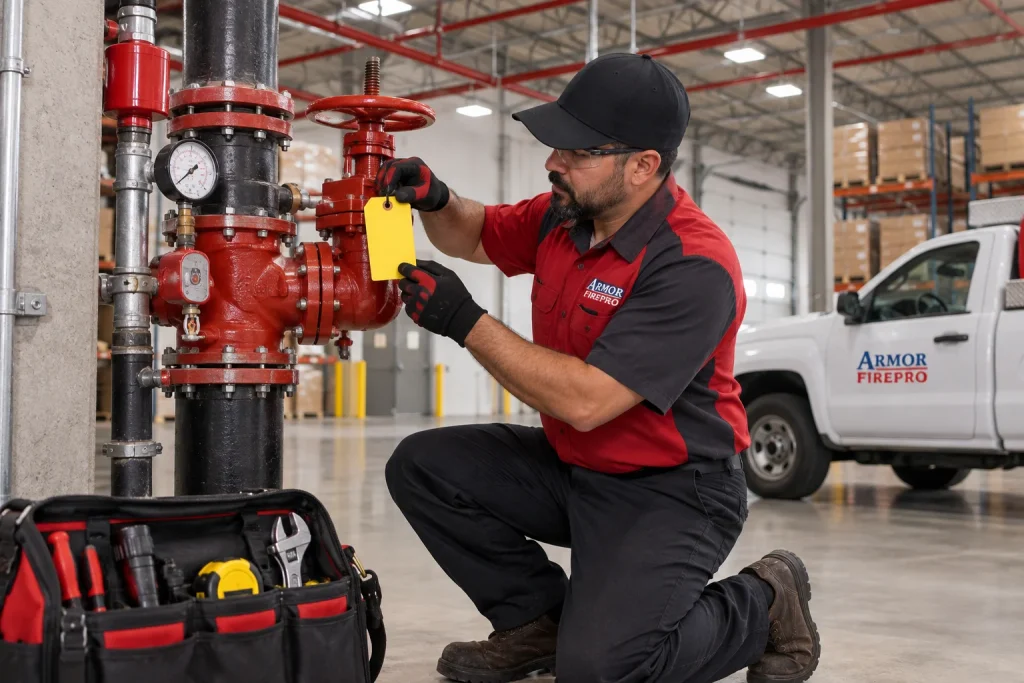
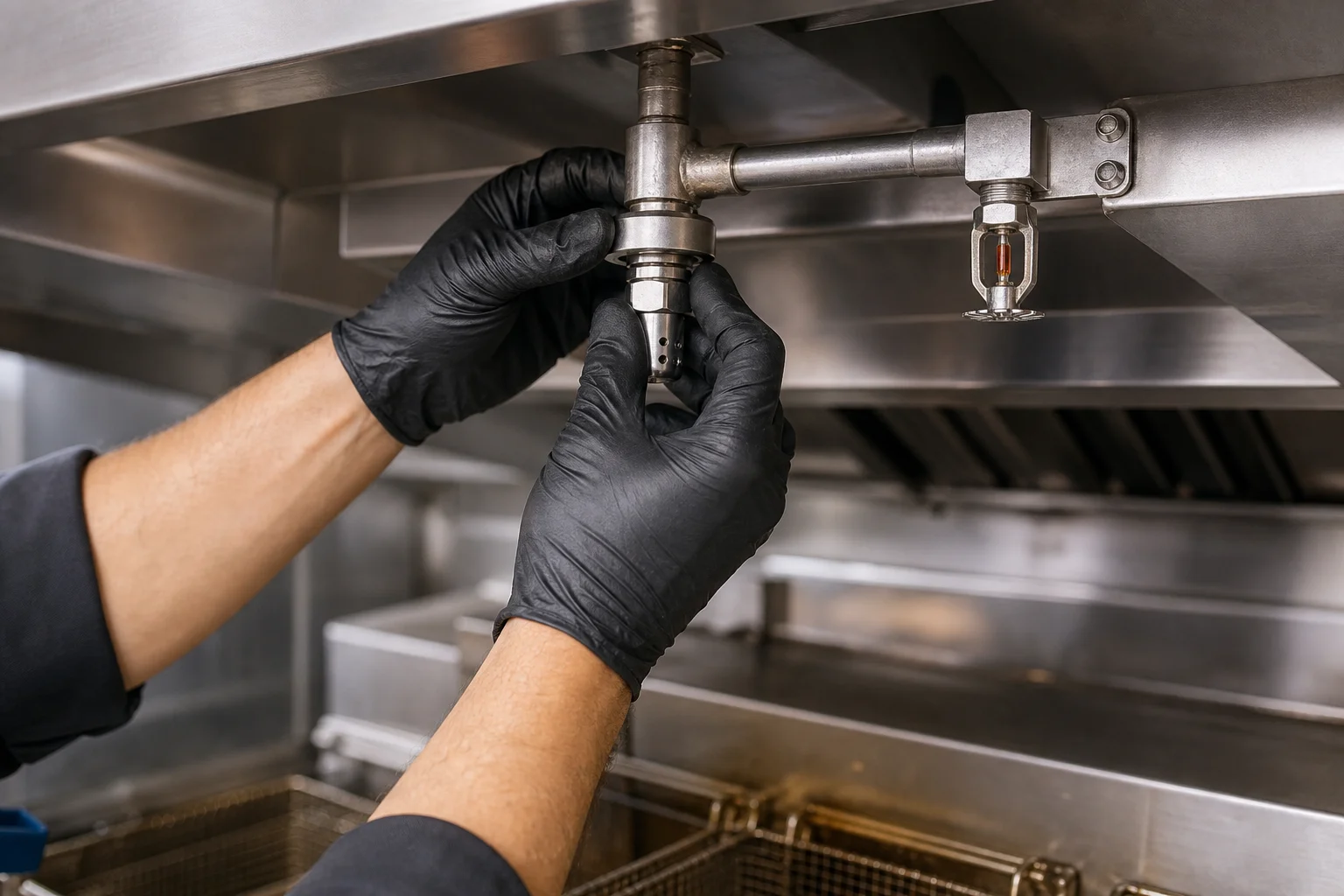
Fire protection technician tagging out an impaired sprinkler control valve during a fire watch in Phoenix

Your Sprinkler System Is Impaired: Fire Watch Rules, Who You Have to Notify, and How Fast to Get It Back in Service

By Blog

When a sprinkler system goes out of service, Phoenix code doesn't give you a grace period: a fire sprinkler impairment fire watch in Phoenix starts within hours, not days. This guide covers who to notify, how long you have, and how Armor Fire Pro gets your Fire Sprinklers back in service before it becomes a violation.

By Armor Fire Pro Team, Fire Protection Specialists

What Does It Mean When a Fire Sprinkler System Is Impaired

A sprinkler system impairment is any condition that takes part or all of your fire protection systems out of normal working order, whether it's a contractor testing a control valve, a burst pipe, a failed inspection, or a fire pump that won't start. NFPA 25, the standard covering inspection, testing, and maintenance of water-based fire protection systems, treats every impairment the same way: as a gap in your building's life-safety coverage that has to be managed, not ignored. Under NFPA 25, a facility experiencing a system impairment is required to name an impairment coordinator, the person responsible for tracking the outage, coordinating repairs, and deciding whether a fire watch is needed until service is restored. In practice, that coordinator is usually a property manager, facilities director, or whoever holds the fire protection contract, not a certification anyone has to earn.

When Is a Fire Sprinkler Impairment Fire Watch in Phoenix Required

Not every impairment triggers a fire watch, but most that last more than an hour or two do. The local authority having jurisdiction (AHJ), the Phoenix Fire Department for most commercial property inside city limits, sets the exact trigger for when a fire sprinkler impairment fire watch in Phoenix has to begin. A system impairment affecting an entire building, a high-occupancy space like a restaurant or assembly hall, or any healthcare, hospitality, or high-rise occupancy usually requires a fire watch to start immediately, with no grace period. A smaller impairment, like one zone out of service while a valve gets repaired, may not require a fire watch at all if the rest of the sprinkler systems stay online and the AHJ signs off. Because thresholds vary by occupancy type and by which local fire department has jurisdiction, the impairment coordinator should call ahead rather than guess.

Who Do You Have to Notify When Your Sprinkler System Goes Out of Service

Four groups need to hear from you, and the order matters. Your alarm monitoring company goes first, so they don't dispatch the fire department on a routine drain-down or false trouble signal while your Fire Alarms & Lights reports the control valve as closed. The local fire department or AHJ comes next: many jurisdictions require notice before work starts and again once the system impaired by repairs is restored to normal service. Your property insurance carrier should know too, since an undisclosed impairment can affect a claim if a fire occurs during the outage. Finally, tell occupants, especially in a multi-tenant property, so people understand the fire protection systems are offline and why a fire watch patrol might be walking the halls. Getting the notification sequence right protects your business from citations and disputed insurance claims.

How Fast Does a Fire Watch Have to Start After an Impairment Begins

Once it's clear a sprinkler system will be out of service past whatever window the AHJ allows, the fire watch has to start immediately, not at the end of the workday. That means continuous patrols at a set interval, commonly every hour, of every area the impaired system would normally protect, with a trained person on-site for as long as the system stays down. If the impairment happens outside business hours or the coordinator can't reach a qualified patrol person right away, most AHJs still expect the affected area to close or clear of occupants until the fire watch is staffed. There's no same-day exception once the trigger threshold is crossed.

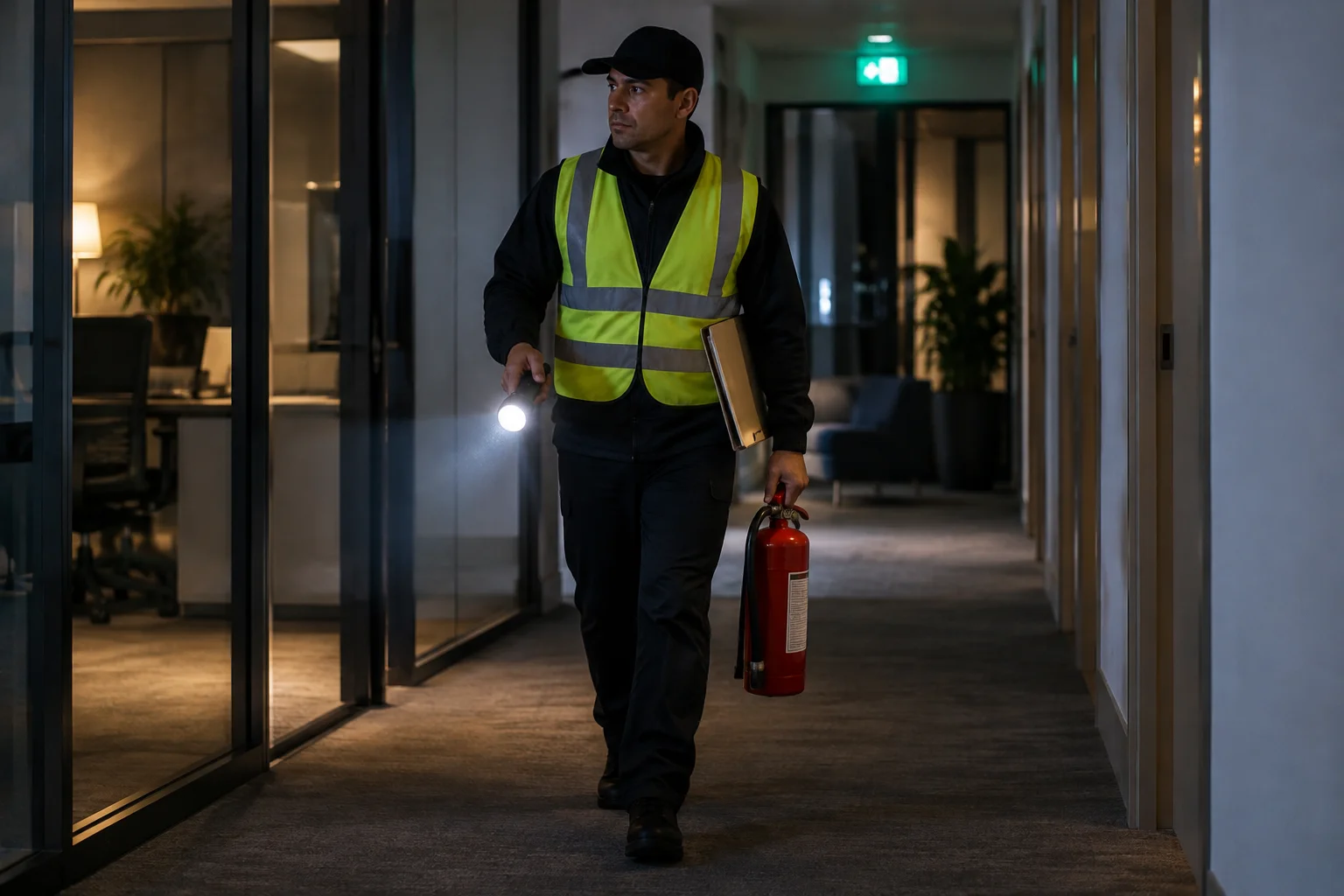
Fire watch patrol officer checking a commercial building corridor during a sprinkler system outage

How Long Can a Sprinkler System Stay Impaired Before It's a Code Violation

There's no universal number. How long a system can stay impaired before it becomes a violation depends on the AHJ, the occupancy, and whether a fire watch is actively covering the gap. Many jurisdictions treat a properly documented, actively fire-watched impairment of roughly 10 days or less as a managed outage rather than a violation. Past that window, or with no fire watch in place, inspectors generally consider the property non-compliant regardless of how the impairment started. That's part of why staying current on inspection testing matters as much as the repair itself: a property that keeps up with its testing maintenance schedule catches most failures before they turn into a multi-day system impairment. Getting ahead of a fire sprinkler impairment fire watch in Phoenix before day ten is always less disruptive than fighting a violation after the fact. Armor Fire Pro's annual fire protection inspections cover the documentation an AHJ will ask for if a violation is ever contested.

What Does a Compliant Fire Watch Actually Involve

A fire watch isn't just someone standing near the front door. Fire watch requirements call for a trained person, carrying a portable fire extinguisher and a reliable way to contact the fire department immediately, patrolling the entire area the impaired system normally protects at the interval the AHJ requires, usually hourly. Procedures should include a written log of every patrol, confirmation that all control valves are back in their normal position once work is done, and a way to sound an alarm or evacuate occupants if a fire starts while the sprinkler systems are down. Every patrol also has to confirm the means of egress stay clear, since a blocked exit turns a manageable impairment into a much bigger risk. The property owner is responsible for staffing and documenting the fire watch, not the fire department; the AHJ's role is to set the requirement and verify compliance, not to provide the patrol.

How Fast Can Armor Fire Pro Get an Impaired Sprinkler System Back in Service

Speed matters because every hour a system stays impaired is another hour of fire watch cost and fire protection risk. Armor Fire Pro dispatches to diagnose the control valve, pipe, or component causing the system impairment, coordinates directly with your monitoring company so alarm monitoring reflects the correct status throughout the repair, and manages the full restoration process from diagnosis to AHJ sign-off. The goal is always to get your sprinkler systems back to normal well inside whatever window your fire sprinkler impairment fire watch in Phoenix allows, so a routine repair never becomes a documented violation.

Frequently Asked Questions

Do I have to notify the Phoenix Fire Department if my sprinkler system is shut down?
In most cases yes. Many AHJs, including local fire departments inside the Phoenix metro, require notice both when a sprinkler system impairment begins and again once it's restored to normal service. Even when notice isn't strictly mandatory for a short, planned outage, calling ahead prevents a mistaken emergency dispatch and gives the AHJ a chance to weigh in on whether a fire watch is needed.

How long can a fire sprinkler system be out of service before it's a violation?
It depends on the AHJ and occupancy, but many jurisdictions treat a properly documented, actively fire-watched impairment of roughly 10 days or less as compliant. Past that window, or with no fire watch covering the gap, most authorities having jurisdiction consider the property out of compliance regardless of why the system went down.

What is considered an impairment under NFPA 25?
NFPA 25 defines an impairment as any situation that takes a sprinkler system, standpipe, fire pump, or water supply out of normal working order, whether planned (testing, repairs, renovation) or unplanned (a broken pipe, a frozen line, a failed valve). Partial outages count too: closing one control valve for a small repair is still an impairment, even if most of the building's fire protection systems stay active.

Can a business stay open during a fire sprinkler impairment?
Usually yes, as long as a compliant fire watch is in place and the AHJ hasn't ordered the space cleared. High-occupancy uses like assembly venues, healthcare facilities, and high-rises get far less flexibility, and some AHJs require closing the affected area until the sprinkler system is restored. The impairment coordinator should confirm with the local fire department before assuming the doors can stay open.

Who is responsible for conducting a fire watch, the building owner or the fire department?
The building owner or their impairment coordinator is responsible for staffing, training, and documenting the fire watch, not the fire department. The AHJ's role is to set the requirement, confirm the property is complying, and respond if there's an actual fire, not to provide the patrol itself.

Get Ahead of Your Next Sprinkler System Impairment

A fire sprinkler impairment fire watch in Phoenix is manageable when you have a fire protection partner who can diagnose the problem fast and document the fix the way your AHJ expects. Request a Free Quote and Armor Fire Pro will walk through what a compliant fire watch and repair timeline looks like for your property.

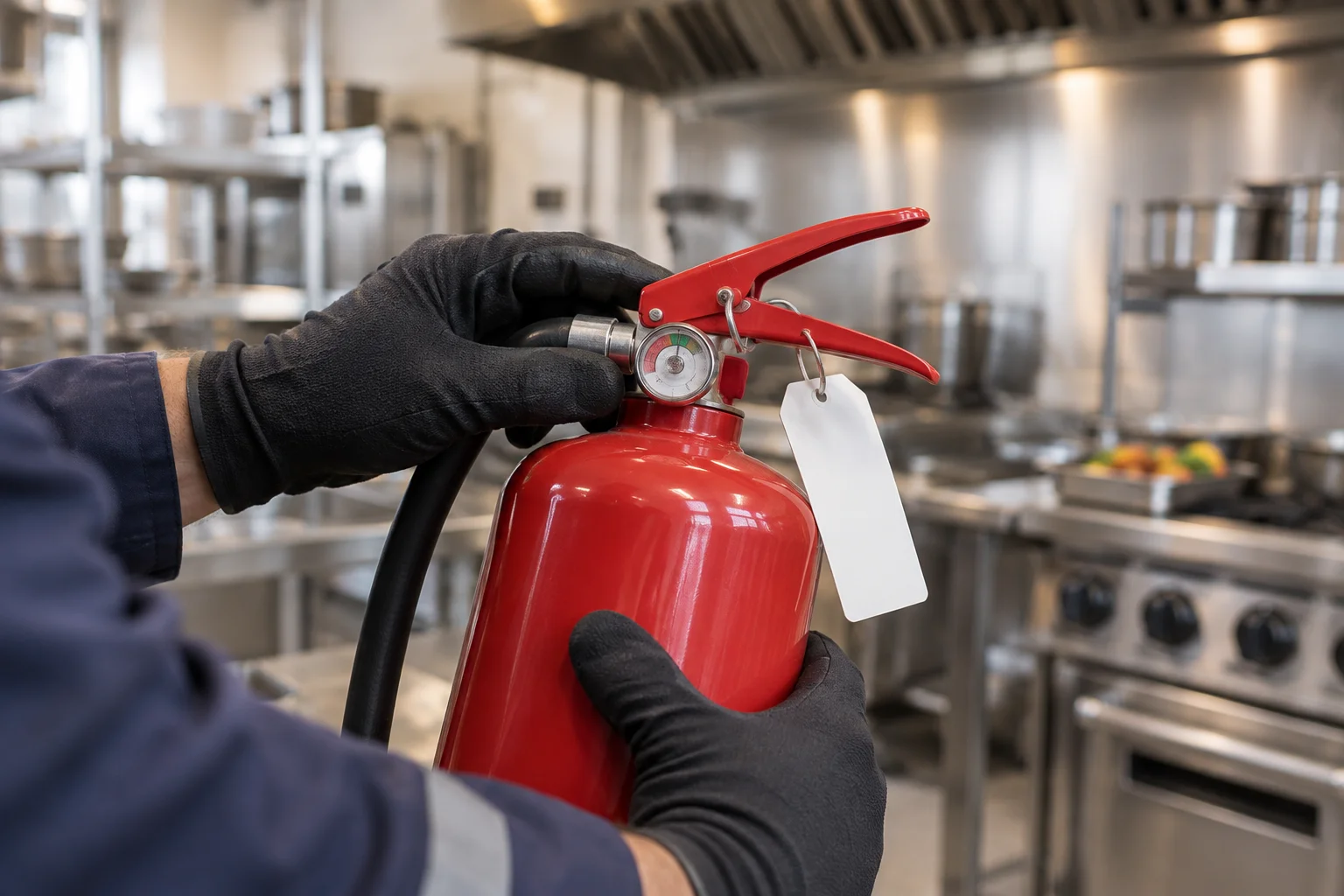
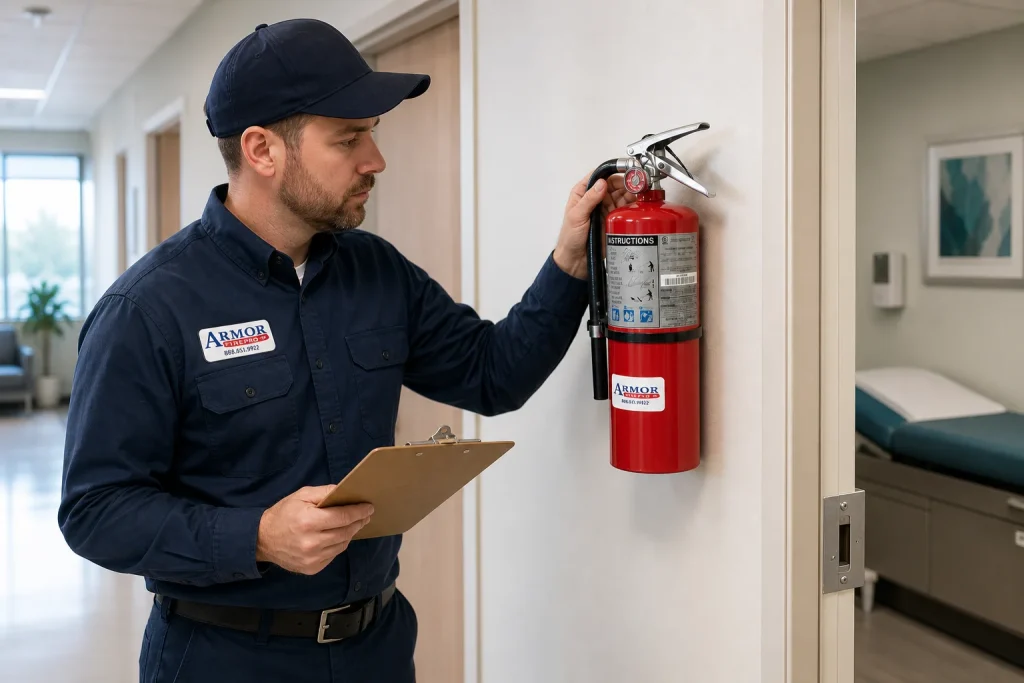
Fire protection technician inspecting an ABC fire extinguisher in a medical clinic hallway near exam rooms

K Class vs ABC vs CO2 Extinguishers: Choosing by Hazard for Medical, Dental and Lab Spaces

By Blog

K Class vs ABC vs CO2 extinguishers each protect against a different fire hazard, and the wrong choice can damage sensitive equipment or fail outright. Medical offices, dental practices, and labs each face distinct risks, from cooking oil to sensitive electronics. The right Fire Extinguishers & Accessories match the hazard, not just the building.

By Armor Fire Pro Team, Fire Protection Specialists

How Do K Class vs ABC vs CO2 Extinguishers Differ by Hazard Type?

Every fire extinguisher is built for a specific class of fire, and mixing that up can make things worse. An ABC extinguisher uses a multi-purpose dry chemical agent effective on ordinary combustibles, flammable liquids, and energized electrical equipment, the same yellow powder mounted in most hallways and break rooms. A K Class extinguisher is different: built for cooking fires involving cooking oil and animal fat, it uses a wet chemical agent that cools the oil and forms a soapy foam layer over it. A CO2 extinguisher displaces oxygen and cools the fire while leaving no residue, making it the choice for electronics and server rooms where dry or wet chemical residue would cause more damage than the fire itself.

Choosing the Right Extinguisher for Medical, Dental, and Lab Spaces

Matching K Class vs ABC vs CO2 extinguishers to each room is less about square footage and more about what's actually inside, cooking equipment, ordinary furnishings, or sensitive electronics.

Which Fire Extinguisher Is Best for a Medical Office or Clinic?

Most medical offices and clinics are best protected by a standard ABC extinguisher placed according to NFPA 10 travel-distance rules. Exam rooms and administrative offices mainly present ordinary combustibles plus electrical risk from monitors and diagnostic devices, and one ABC extinguisher covers both. A breakroom with a stove or fryer usually needs its own K Class unit, since a cooking fire is a different hazard than an electrical fire at a nurses' station.

Do Dental Offices Need a Class K Fire Extinguisher?

Usually not, unless the practice has a breakroom with cooking equipment that can produce a grease or oil fire, like a countertop fryer or grill. A dental exam room or sterilization area doesn't typically present that hazard, so ABC coverage is generally sufficient there. The deciding factor is whether cooking oil is present anywhere in the facility.

Why Do Labs and Server Rooms Use CO2 Extinguishers Instead of ABC?

Dry chemical agents work well, but the powder is corrosive to electronics and leaves residue that can damage lab instruments and servers. A CO2 extinguisher displaces oxygen and cools the fire without depositing anything on the equipment, so labs and server closets are often equipped with CO2 alongside standard ABC coverage. CO2 is less effective on ordinary combustibles like paper, so it's a supplement, not a full replacement.

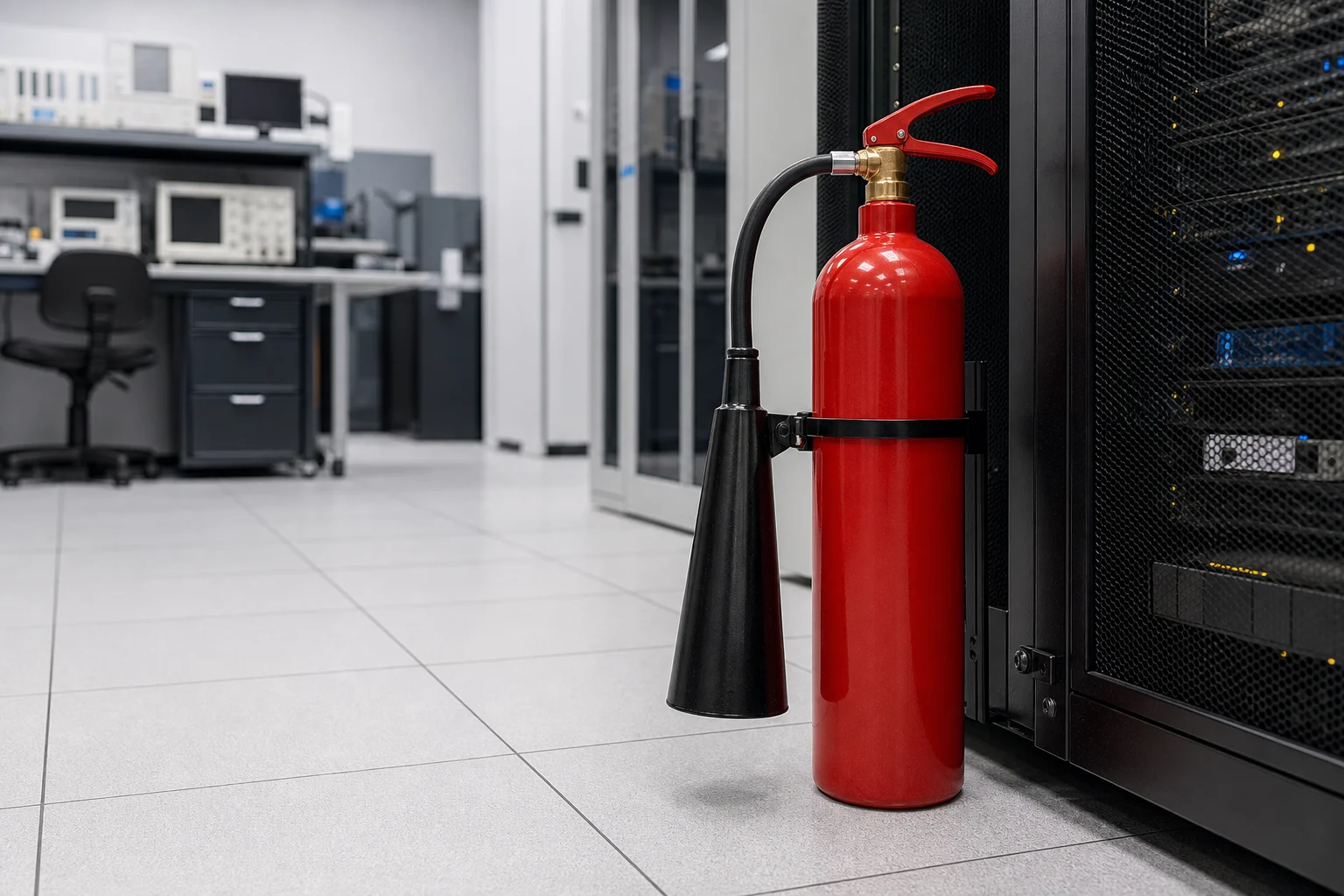
Fire protection technician inspecting a CO2 fire extinguisher near lab equipment in a medical facility

CO2 Extinguisher Safety and Composition

Is a CO2 Extinguisher Safe to Use Around Medical or Lab Equipment?

Yes, a CO2 extinguisher is generally the safest option around medical and lab equipment because it leaves no residue and won't damage electronics the way a dry chemical agent can. CO2 discharges at high pressure and extreme cold, so avoid direct contact with the horn; discharging in a small enclosed room can temporarily reduce oxygen levels. Ventilate a confined lab or server closet after use, even though the agent itself isn't toxic.

What's Inside a CO2 Extinguisher and Why Does It Leave No Residue on Equipment?

A CO2 extinguisher holds liquid carbon dioxide stored under pressure. When discharged, it expands rapidly into a gas that forms a cooling cloud and displaces oxygen. Because carbon dioxide is a gas at room temperature, it dissipates into the air after use instead of leaving behind powder, foam, or moisture. That's why CO2 is standard near circuit boards and lab instrumentation: nothing is left to short out a connection afterward.

NFPA 10 Requirements for Healthcare Facilities

How Many and Which Types of Extinguishers Does NFPA 10 Require for Healthcare Facilities?

NFPA 10 sets minimum extinguisher placement based on occupancy hazard level and travel distance, not a flat per-square-foot number, so the count depends on a facility's layout and hazard classification. Most medical and dental offices fall under light or ordinary hazard occupancy, calling for a rated extinguisher within a set travel distance, plus supplemental Class K or CO2 units wherever cooking equipment or sensitive electronics are present. Because the requirement varies by floor plan and local code, a facility-specific placement plan beats a generic rule of thumb.

What Size Fire Extinguisher Is Required for a Dental Exam Room or Lab Space?

There's no size requirement tied to an individual exam room. NFPA 10 works off travel distance across the facility, so one properly rated hallway unit can cover several exam rooms if no point exceeds the maximum distance. A 5 lb or 10 lb ABC unit is common for these areas, with exact size depending on the hazard class assigned. Lab spaces with sensitive equipment often add a dedicated CO2 unit near the equipment, in addition to standard ABC coverage.

Handling Electrical and Grease Fire Risks in Medical and Dental Offices

What Extinguisher Should I Use for an Electrical Fire in a Dental or Medical Office?

For an active electrical fire involving energized equipment, an ABC extinguisher is rated for it, since the dry chemical agent doesn't conduct electricity back through the stream. In rooms with expensive electronics or servers, a CO2 extinguisher is often preferred since it leaves no residue. When it's safe, cut power to the equipment or circuit first, which lowers reignition risk.

Can You Use an ABC Extinguisher on a Grease or Kitchen Fire?

A small ABC extinguisher can knock down a minor grease fire, but it isn't recommended: the dry chemical can scatter burning oil, and the fire can reflash once the powder settles. A Class K extinguisher with a wet chemical agent is built for cooking oil fires, cooling the oil and forming a soapy foam layer that seals off oxygen and helps prevent reignition. Any breakroom with a stove, fryer, or grill should have a dedicated K Class unit as part of its Kitchen Fire Suppression coverage, rather than relying on the building's general ABC extinguishers. For a full commercial kitchen setup, a wet chemical suppression system designed for cooking oils provides continuous protection a handheld extinguisher can't match.

Can a K Class Extinguisher Be Used on an Electrical Fire?

No. A Class K extinguisher discharges a wet chemical agent, and water-based agents aren't rated for electrical fires because the stream can conduct electricity back to the operator. Class K units are built exclusively for cooking oil and grease fires and shouldn't be substituted for an ABC or CO2 extinguisher when electrical equipment is involved.

How Often Do Medical and Dental Offices Need Fire Extinguisher Inspections?

Fire extinguishers in a medical or dental office generally need a monthly visual check, confirming the gauge shows full pressure and the pin and seal are intact, plus an annual inspection by a licensed technician. Facilities in Arizona should also plan for periodic hydrostatic testing and, for CO2 and dry chemical units, internal maintenance on a schedule set by extinguisher type and local fire code. Healthcare facilities are inspected closely, so a current inspection tag is usually one of the first things a fire marshal checks.

Frequently Asked Questions

How many fire extinguishers does a small dental office need?
It depends on layout and hazard classification under NFPA 10, not a fixed number, since placement is based on travel distance rather than room count. Most small practices need at least one ABC extinguisher positioned so no point exceeds the maximum travel distance, plus a Class K unit if there's a breakroom with cooking equipment.

Can a CO2 extinguisher be used on a Class K fire?
No. CO2 can't cool and seal a deep-fat fire the way a Class K wet chemical agent does, and the oil can reignite once the CO2 disperses. Cooking oil and grease fires need a dedicated Class K unit; CO2 stays reserved for electrical and electronic equipment where residue is the concern.

What color is an ABC fire extinguisher label?
ABC fire extinguishers typically carry a label showing the letters A, B, and C to indicate it's rated for ordinary combustibles, flammable liquids, and electrical fires. The extinguisher body itself is usually the red commonly associated with fire equipment.

Do server rooms need special fire extinguishers?
Usually, yes. A server room's main risk is sensitive electronic equipment, so CO2 is typically preferred over ABC since it won't leave residue that can damage boards and connections. A portable CO2 unit is the typical baseline for the space.

How long does a CO2 fire extinguisher last before it needs service?
A CO2 extinguisher generally needs a hydrostatic test on a schedule set by code, and should be weighed periodically since CO2 units rely on stored weight, not a gauge, to confirm they're still charged. An annual inspection confirms a unit is within its service window.

Get the Right Fire Extinguishers for Your Medical or Dental Facility

Getting K Class vs ABC vs CO2 extinguishers matched to the actual hazards in your medical, dental, or lab space keeps a facility genuinely protected, not just code-adjacent. Request a Free Quote and we'll confirm the right extinguisher types, sizes, and placement for every room.

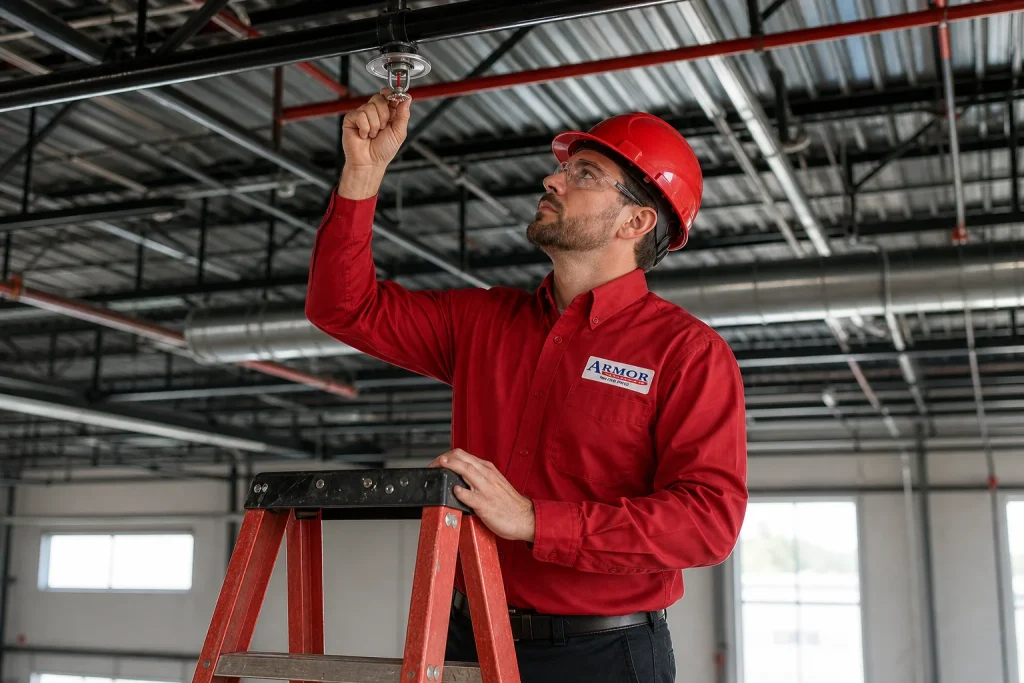
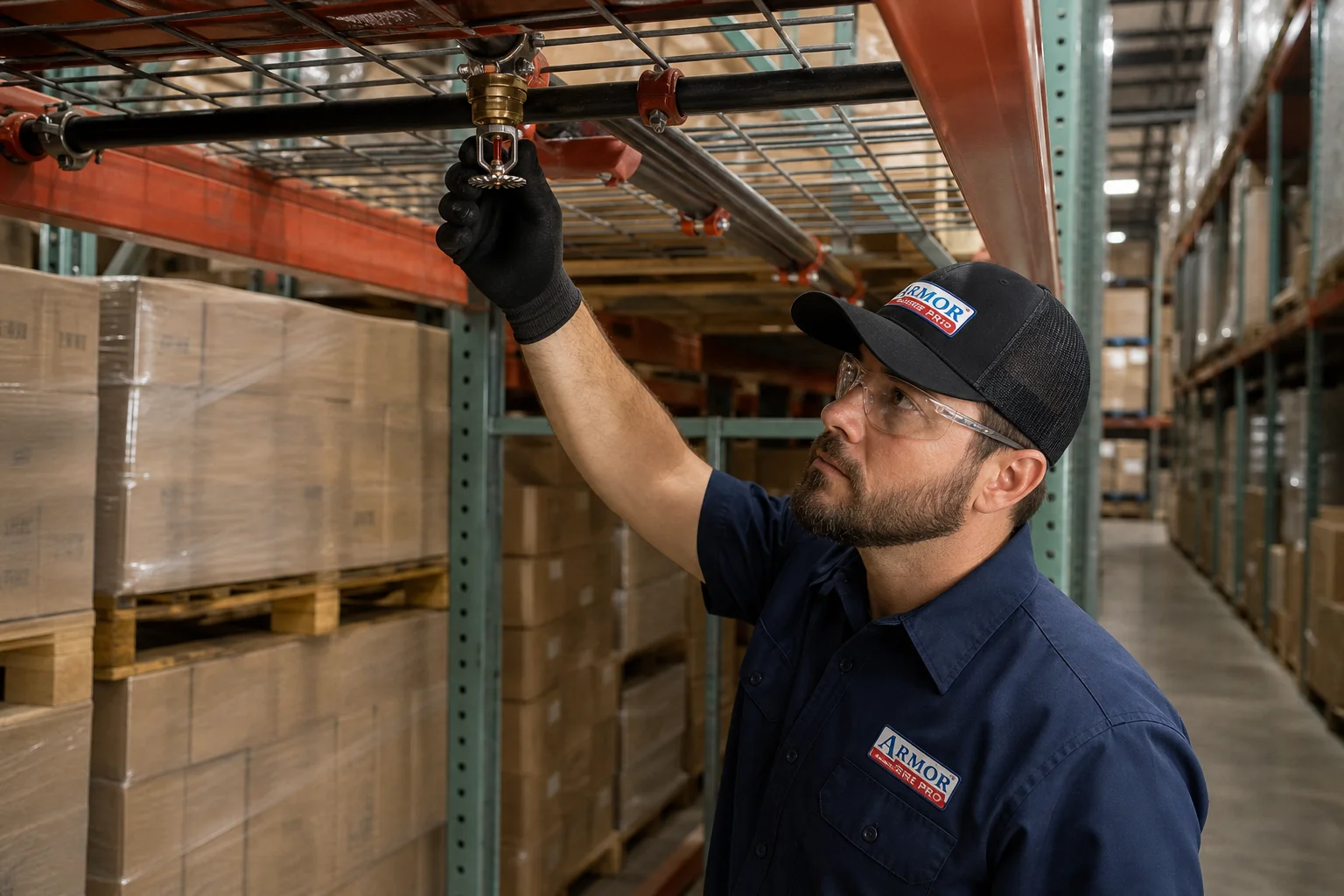
Fire protection technician inspecting a sprinkler head during a fire protection system upgrade in a commercial warehouse

Fire Protection System Retrofits: Upgrading Legacy Systems for Code Compliance

By Blog

If your commercial building still runs on a fire protection system installed decades ago, it may no longer meet current safety standards or protect the people inside during a fire. Fire protection system upgrades bring aging Fire Sprinklers, fire alarms, and suppression equipment up to code, close coverage gaps, and reduce liability for building owners across the Phoenix area.

By Armor Fire Pro Team, Fire Protection Specialists

Signs Your Fire Protection System Needs an Upgrade

Most fire protection systems are engineered to last twenty to thirty years, assuming routine maintenance and no major building changes. Signs of a system that has fallen behind include corroded sprinkler heads, an alarm panel with no replacement parts available, frequent false alarms, water stains near ceiling piping, or coverage gaps in areas added after the original design. Insurance carriers often flag outdated equipment during renewal inspections, and a fire marshal walkthrough can turn up related violations. If your building has changed occupancy, added square footage, or gone years without evaluation, have a licensed contractor assess it before a violation, or a fire, forces the issue.

Codes and Standards That Drive Fire Protection System Retrofits

Retrofits bring an older building's equipment up to current code. NFPA 13 governs fire sprinkler design, NFPA 72 governs fire alarm and detection systems, and the International Fire Code sets the baseline Arizona jurisdictions adopt and amend locally. A newer code edition does not always force a retrofit right away, but a triggering event, such as a change of occupancy or a major renovation, can require it. Arizona fire code compliance follows local amendments layered on the NFPA baseline, so owners unsure which edition applies should confirm with their authority having jurisdiction before assuming an older system is grandfathered in.

What Fire Protection System Upgrades Cost

There is no flat number for what upgrades cost, because pricing depends on building size, how many systems need work, whether the retrofit can reuse existing piping and wiring, and how much design and permitting the project needs. A single alarm panel replacement costs far less than a full sprinkler retrofit across a multi-story office building. The only reliable way to know the cost is a walkthrough and written proposal from a licensed contractor, requested early since scope often shifts once the contractor sees the system.

How the Retrofit Process Works

A fire protection system retrofit follows a fairly consistent sequence.

From Assessment to Final Inspection

A licensed contractor inspects the existing sprinkler, alarm, or suppression equipment, checks it against current code, and identifies gaps. The contractor then designs the retrofit, submits plans to the fire marshal or building department for approval, and schedules installation. The new equipment then goes through acceptance testing and a final inspection before sign-off.

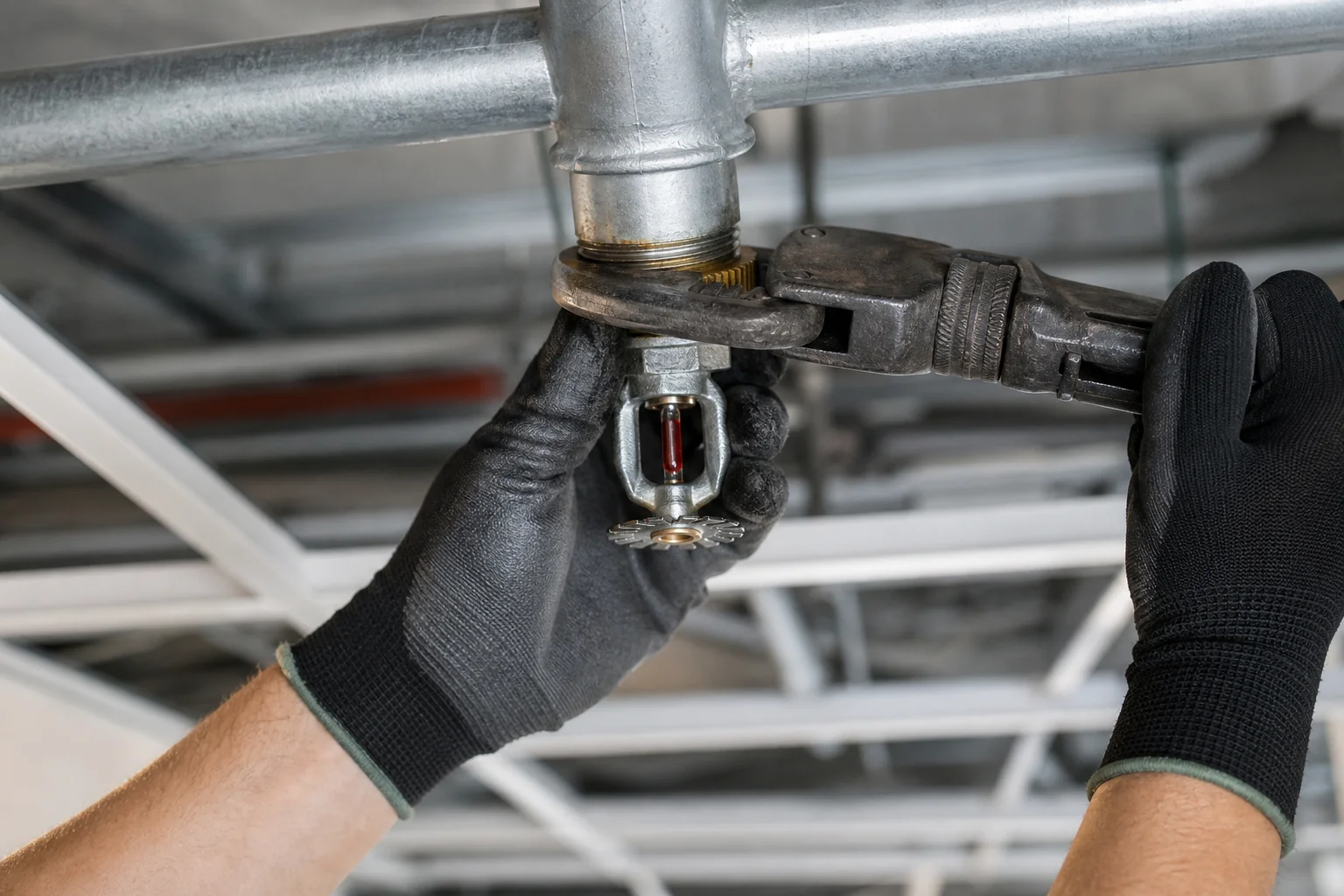
Fire protection technician installing a new sprinkler head into overhead commercial ceiling piping during a system retrofit

How Long a Retrofit Takes

A single alarm panel swap can be finished in a day or two. A full sprinkler retrofit across a large building, including design, permitting, and phased installation, more commonly takes several weeks to a few months. Permitting delays are usually the biggest variable, not installation itself.

Keeping the Building Operational

Most retrofits can be phased so the building does not have to close. Contractors typically work floor by floor or system by system, maintaining fire watch coverage where protection is temporarily offline. Occupied buildings, hospitals, hotels, and multi-tenant offices usually need this phased approach built into the plan.

Which Fire Protection Systems Get Retrofitted Most Often: Sprinklers, Alarms, and Suppression

Sprinkler systems are the most commonly retrofitted because they age out fastest: older pipe materials corrode, coverage falls out of compliance as buildings are renovated, and dry systems in unconditioned spaces are especially prone to failure. Fire Alarms & Lights are a close second, often replaced because parts for older panels are discontinued or added square footage falls outside the original alarm zoning. Kitchen suppression systems also see frequent retrofits, usually to bring wet chemical suppression systems up to current standards or replace an aging dry chemical system that no longer matches the layout. A retrofit to one system does not extend to the others; each stays on its own schedule.

What Happens When a Building Skips Its Retrofit

A building that fails to retrofit an outdated fire protection system risks more than a citation. Insurance carriers can deny claims tied to a system that was out of compliance at the time of a loss, and some will not renew coverage until violations are corrected. Local fire marshals can red tag noncompliant occupancies, shutting down operations until the system is current. Beyond the paperwork, an outdated system performs worse when it matters most: sprinkler heads activate slower, alarm panels miss zones they were never designed to cover, and suppression systems sized for a different layout may not protect the space. These systems protect people first and property second, and outdated ones increase risk for everyone inside.

Renovations and Who Owns Compliance

Renovation Triggers

Most jurisdictions require a fire protection system to meet current code when a building undergoes a substantial renovation, even if it was compliant before. Adding square footage, changing occupancy type, or altering the layout enough to change sprinkler coverage are common triggers. Owners planning a renovation should have the system reviewed during permitting, not after construction, since retrofitting around finished walls costs more than building it in.

Who's Responsible

Keeping a commercial building's fire protection system code compliant is generally the owner's responsibility, though property managers and tenants may share day-to-day duties depending on the lease. Ownership of inspections, testing, and any required retrofit work usually falls to whoever holds the certificate of occupancy. Multi-tenant buildings sometimes split responsibility by lease terms, but the fire marshal holds ownership accountable regardless of any internal agreement.

Frequently Asked Questions

How often does a fire protection system need to be inspected after a retrofit?
Fire sprinkler systems typically need annual inspection and testing after a retrofit, with more frequent checks for components like fire pumps. Fire alarm systems generally follow a similar annual cycle, though local requirements vary. Confirm the exact schedule with your contractor and fire marshal, since some jurisdictions require closer checks the first year.

Is a fire protection system retrofit covered by insurance or tax incentives?
Coverage and incentives vary by carrier, property type, and jurisdiction, so there is no universal answer. Some insurance carriers offer premium credits for updated systems, and certain municipalities occasionally offer incentives tied to life safety upgrades. Ask your insurance broker and a tax professional before assuming a retrofit qualifies.

Is a fire protection system retrofit legally required for older buildings?
It depends on the triggering event rather than age alone. An older building is not automatically required to retrofit just because it predates the current code, but a renovation, occupancy change, or a violation found during inspection can require it to meet current standards. Confirm with your local authority having jurisdiction if unsure.

What's the difference between a retrofit and a full system replacement?
A retrofit upgrades specific components, such as adding sprinkler coverage to a renovated area or replacing an outdated alarm panel, while leaving compatible infrastructure in place. A full replacement removes and reinstalls the entire system, usually because existing piping, wiring, or panel architecture is too outdated to integrate with new equipment.

Get a Straight Answer About Your Building's Fire Protection System

An outdated fire protection system is a liability that gets more expensive to fix the longer it sits. Armor Fire Pro can assess sprinklers, alarms, and suppression systems together to ensure your building meets code, request a Free Quote to get started.

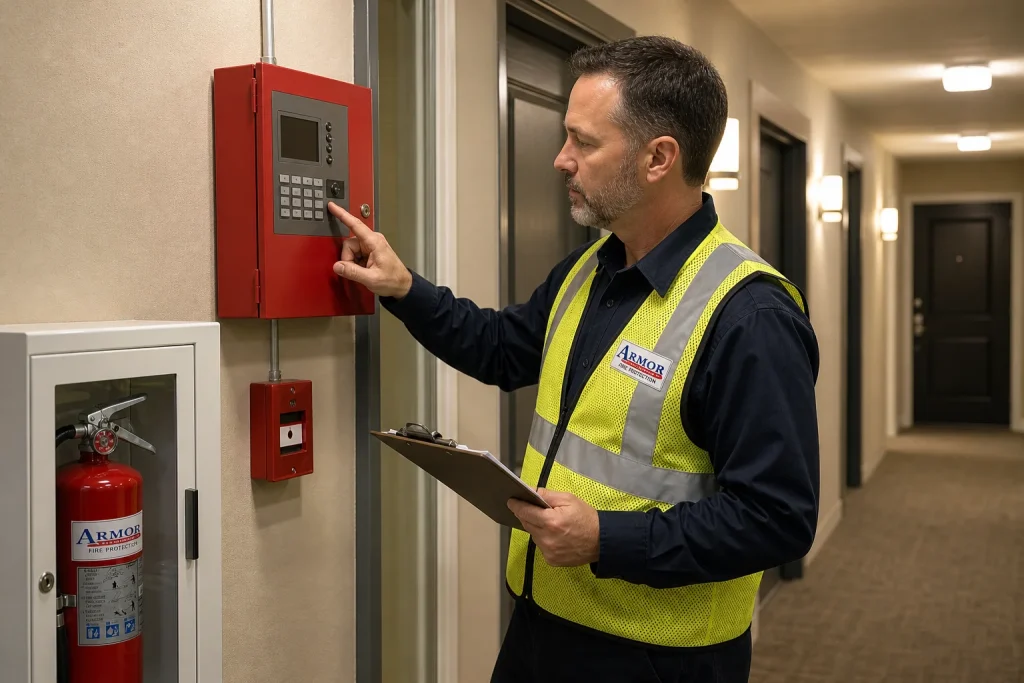
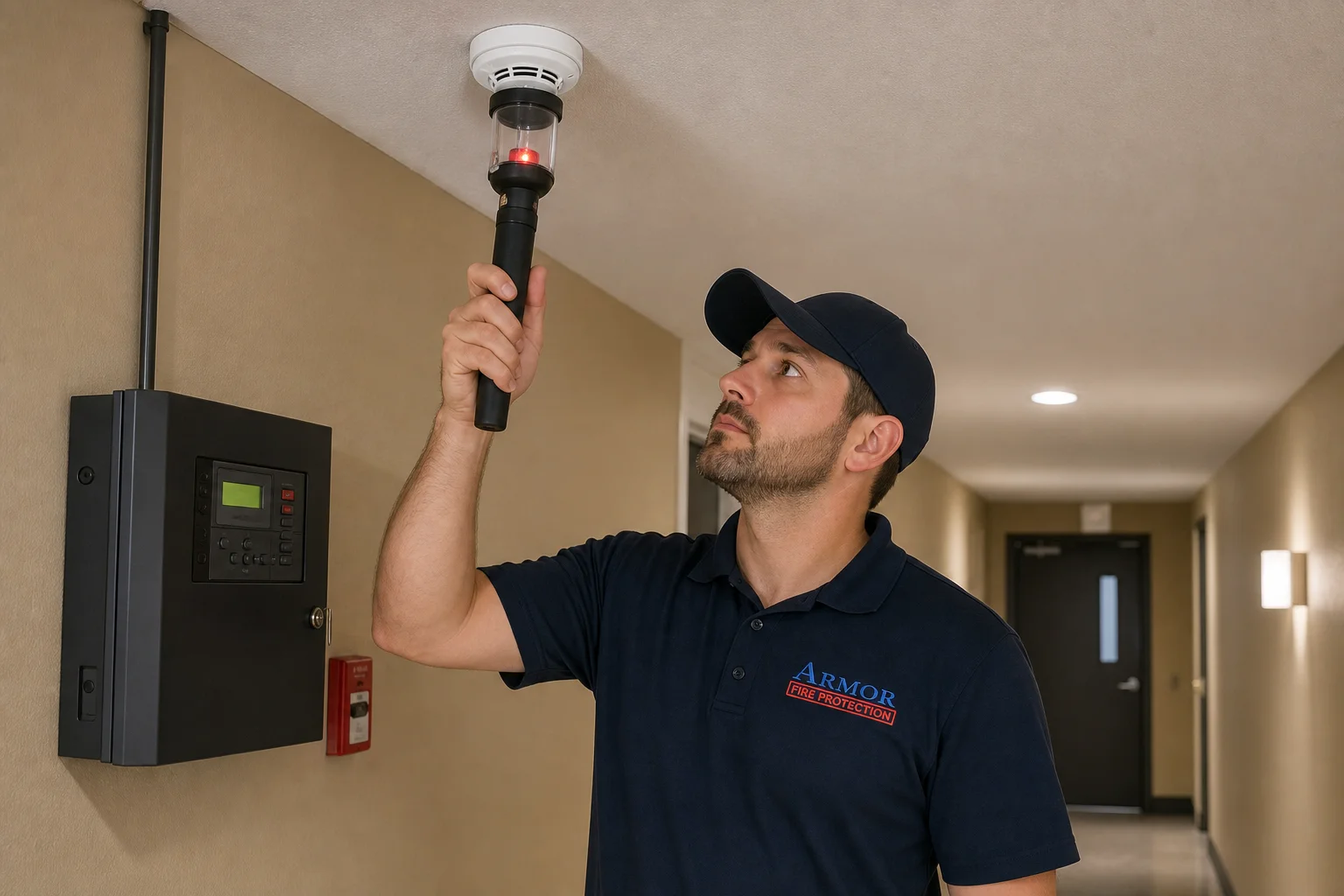
Fire protection technician testing a fire alarm control panel in a multifamily apartment hallway

Fire Alarm Testing Requirements for Multifamily and HOA Properties: Who Is Liable When a Test Is Missed

By Blog

Fire alarm testing requirements for multifamily and HOA properties are set primarily by NFPA 72 and enforced locally, and missing a scheduled test can leave a board, management company, or unit owner exposed to real liability. Armor Fire Pro's Fire Alarms & Lights team explains who is responsible, what the code demands, and what happens when a test gets skipped.

By Armor Fire Pro Team, Fire Protection Specialists

How Often Do Fire Alarm Systems Need to Be Tested in Multifamily and HOA Properties?

Along with fire extinguishers, sprinklers, and emergency lighting, the fire alarm system is one of the most heavily tested life safety systems in a multifamily building. Testing frequency depends on the device, not a single blanket schedule. NFPA 72 divides a fire alarm system into components that each carry their own required test interval: smoke detectors and other initiating devices are typically tested annually, while the fire alarm control panel, notification appliances (horns and strobes), and monitoring connections to the local fire department are checked on a cycle that can include monthly, quarterly, and semiannual visits depending on the equipment and occupancy type. Multifamily and HOA properties usually fall under the same testing table as any other commercial occupancy, since common hallways, stairwells, and shared amenity spaces are treated as commercial space even when the units themselves are residential. Scheduling NFPA 72 fire alarm testing on the correct interval, not just once a year, is the single biggest factor in avoiding a violation. A qualified inspector documents each interval separately, so a property is rarely finished with fire alarm testing after a single annual visit.

Who Is Legally Responsible for Fire Alarm Testing in an HOA or Condo Building?

Responsibility for fire alarm testing usually sits with the entity that owns and controls the building's common areas, which in most HOA and condo structures is the association itself, acting through its board of directors. The board can hire a management company or licensed fire protection contractors to schedule and perform the actual testing, but delegating the task does not delegate the underlying duty. Governing documents such as CC&Rs and bylaws typically confirm that fire safety and life safety systems in common areas are an association responsibility, separate from anything an individual unit owner maintains inside their own unit. In a straight rental apartment community, the property owner or management company holds that same duty. Either way, confirm in writing who is contracted to test the system and how often, rather than assuming it is being handled.

Fire Alarm Testing Requirements for Multifamily and HOA Properties: What NFPA 72 and Local Fire Codes Actually Require

NFPA 72, the National Fire Alarm and Signaling Code, sets the baseline testing methods and minimum frequencies that most fire departments reference, and it is the standard almost every local fire code builds on. Local jurisdictions often adopt NFPA 72 with amendments, so the exact frequency, paperwork, and inspector qualifications that apply to a given building can shift once local Arizona fire code requirements are layered on top of the base standard. That is why the fire alarm testing requirements for multifamily and HOA properties in one city can differ slightly from a neighboring one, even though both reference the same underlying NFPA 72 code. Confirming the locally adopted code edition, and any local amendments to test frequency or reporting, is part of establishing a compliant fire alarm system baseline for any HOA or apartment community.

Fire protection technician testing a ceiling smoke detector during scheduled fire alarm testing in an apartment hallway

What Happens if an HOA Board or Property Manager Misses a Required Fire Alarm Test?

Missing a scheduled test rarely triggers an immediate penalty, but it starts a chain of exposure that grows the longer it goes uncorrected. A local fire marshal who finds an expired test tag during a routine inspection will typically issue a correction notice with a deadline to retest, and a second missed deadline can escalate to fines, a formal violation on the property's file, or in more serious cases restrictions on occupancy until the fire alarm system is verified working. Beyond the code violation itself, an untested alarm system that fails during an actual fire event turns a compliance problem into a life safety failure, a very different conversation with residents, insurers, and attorneys. Even a partial miss, such as testing devices but skipping the required monitoring connection check, can leave a property technically out of compliance without anyone realizing it until the next inspection.

Can an HOA Board, Management Company, or Unit Owner Be Held Liable for a Missed Fire Alarm Test?

HOA fire alarm liability almost always traces back to whoever held the testing duty and did not act on it. Liability generally follows whoever held that duty, though the exact answer depends on the governing documents, the applicable state law, and the specific facts of what happened. An HOA board that never scheduled testing, or a management company that was contracted to test but did not, can each face separate exposure in a negligence claim if a preventable fire alarm failure contributes to an injury or property loss. Individual unit owners are rarely liable for common-area alarm testing unless the governing documents shift that duty to them directly. A board with any doubt about its exposure should talk to its attorney, and should confirm its testing contract with a licensed fire protection provider covers its full range of Services, not just a partial system check.

Who Is Qualified to Perform Fire Alarm Testing: a Licensed Technician or In-House Staff?

Fire alarm testing is not a task that general maintenance staff can perform and self-certify, even when they are capable of basic troubleshooting. Most jurisdictions require testing to be performed and signed off by a licensed, qualified fire protection contractor, often a technician holding a NICET certification or an equivalent state license, because the test results become part of the official compliance record submitted to the local fire authority. In-house staff can handle day-to-day visual checks, such as confirming a panel shows no trouble signals or that nothing is blocking a smoke detector, but the formal, code-required test and its paperwork need a licensed professional. Hiring a contractor already familiar with a property's specific fire alarm system also tends to catch small issues, like a battery nearing end of life, before they become a failed test.

What Records or Documentation Prove Fire Alarm Testing Compliance to Inspectors or Insurers?

Documentation is what turns a completed test into provable compliance. A complete record typically includes a dated inspection report listing every device tested, any deficiencies found and how they were corrected, the technician's license or certification number, and a current test tag on the control panel itself. These records typically live alongside an annual inspection certification that many local fire departments require the property to keep on site and produce on request. Insurers increasingly ask for the same paperwork during renewal or after a claim, since a lapsed or missing test record can affect how a fire-related claim is handled. Boards and management companies should keep at least the last several years of test reports in an accessible file, since a change in vendors can otherwise create a documentation gap that looks identical to a missed test.

Frequently Asked Questions

Is fire alarm testing legally required for condos and apartment buildings?
Yes. Understanding the fire alarm testing requirements for multifamily and HOA properties starts with knowing that any building with a fire alarm system, condo or apartment, is generally required to have that system tested on the schedule set by NFPA 72 and adopted by the local fire code. This applies to common-area systems even when individual units are privately owned.

What is the fine for not testing a fire alarm system in a multifamily property?
Fines vary by jurisdiction and by how long a violation goes uncorrected, so there is no single number that applies everywhere. A first missed test often results in a correction notice rather than an immediate fine, but repeated or ignored violations can escalate into recurring fines and, in serious cases, occupancy restrictions until the system passes inspection.

Does homeowners or HOA insurance still pay out if a fire alarm was never tested?
It depends on the policy, but an untested or non-compliant fire alarm system can give an insurer grounds to dispute or reduce a claim, particularly if the lack of testing contributed to how much damage occurred. Reviewing the policy's maintenance and compliance requirements with the association's insurance agent is the safest way to confirm coverage before a loss happens, not after.

How much does fire alarm testing cost for an HOA or apartment complex?
Cost depends on the size of the property, the number and type of devices on the system, and how the local code requires those devices to be tested. A small community with a basic system generally costs less to test than a large complex with multiple buildings and a monitored, multi-zone system. A licensed provider can give an accurate cost after reviewing the property.

Who is liable if someone is hurt in a fire and the alarm system wasn't working?
Liability in that situation typically depends on who had the duty to maintain and test the system and whether that duty was met, a fact-specific negligence question decided under state law. An HOA board, a management company, or a testing contractor could each potentially share responsibility depending on what the investigation and governing documents show, which is why legal counsel should be involved early after any injury.

Get a Free Quote for Fire Alarm Testing and Compliance

Armor Fire Pro tests, maintains, and certifies fire alarm systems for HOA boards, condo associations, and apartment communities across the Phoenix area, so your property stays code compliant and residents stay safe with real peace of mind. Request a Free Quote to get your installed system's testing schedule and next inspection date on the calendar.

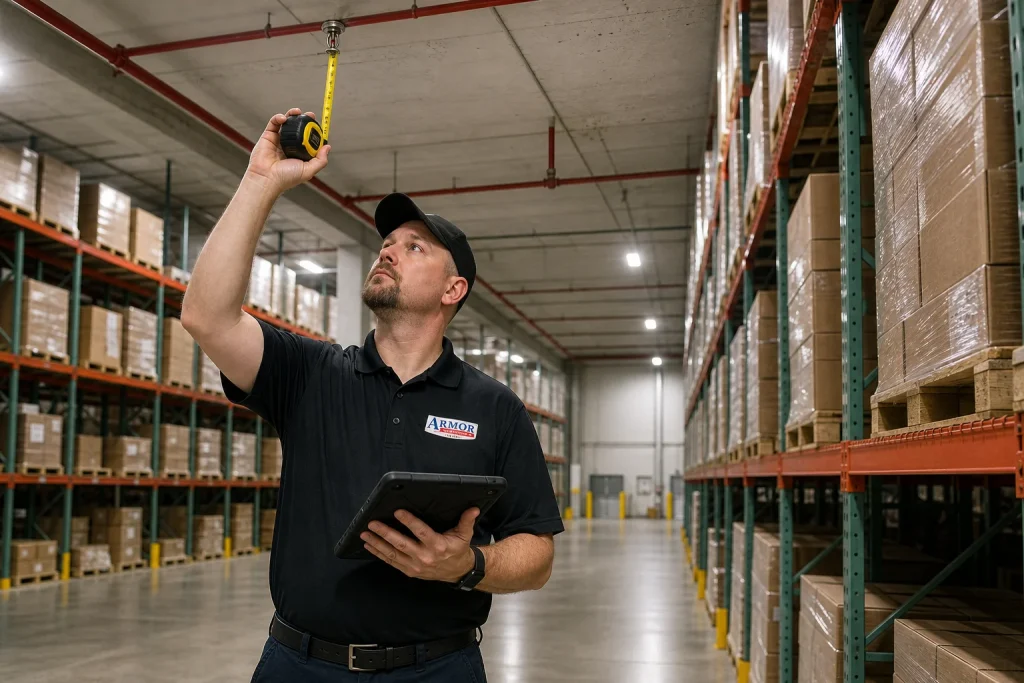
Fire protection technician measuring sprinkler clearance above tall warehouse pallet racks after a rack height and stored product change

You Changed Rack Height or Stored Product: When a Warehouse Sprinkler Design Stops Complying

By Blog

If you changed rack height or stored product in your Phoenix warehouse, your fire sprinkler system may no longer match its original design. Every Fire Sprinklers system is engineered around a specific commodity class and storage height, and moving past either one without a review can leave your building non-compliant and dangerously underprotected.

By Armor Fire Pro Team, Fire Protection Specialists

How Raising Rack Storage Height Changes Your Sprinkler System's Fire Code Requirements

When you changed rack height or stored product in your facility, you changed the fire dynamics the sprinkler design was built around. NFPA 13 calculates sprinkler density, water demand, and clearance based on a maximum storage height, a fixed ceiling height, and a defined commodity class. Add beam levels to an existing rack run and you increase both the storage height and the fuel load sitting in that space, even if the footprint of the warehouse never changes.

Any adjustment to your warehouse racking, whether taller uprights, extra beam levels, or a tighter aisle layout, reduces the clearance between the sprinkler deflector and the top of storage. Less clearance means the automatic sprinkler system has less time and less room to control a fire before it reaches the ceiling. Once storage height exceeds the number the original hydraulic calculation was based on, the system is operating outside its designed range, whether or not anyone has noticed yet.

Is a New Hydraulic Calculation Required Every Time Rack Height Increases?

Not for every minor adjustment, but in many cases, yes. A hydraulic calculation is what proves the water supply, pipe sizing, and sprinkler spacing can still deliver the required density at the new storage height. A small change within the original design's stated range may not trigger a redo. An increase that pushes past the design height, adds plastic commodities, or changes the rack layout usually does, and that determination should come from a licensed fire protection engineer or your contractor, not a guess.

What Counts as a Change in Stored Product That Can Make a Sprinkler System Non-Compliant

A sprinkler system isn't just designed around height, it's designed around commodity class. Moving from Class I-II cartoned goods to unencapsulated plastics, aerosols, or flammable liquids changes the required water density dramatically, even if the rack height and floor footprint stay exactly the same. Cartoned versus exposed plastic matters too: the same product in different packaging carries a different fire load.

Other changes that count: switching from idle pallet storage to loaded pallet racks, adding a new tenant with a different product line, introducing rubber, foam, or rolled paper, or storing product at a higher density per rack module than the original design assumed. Any of these can move a warehouse into a higher commodity class, and a system built for Class II storage will not necessarily control a fire in Class IV or plastic commodities.

How to Check If Your Sprinkler Design Still Matches After You Changed Rack Height or Stored Product

Start with the hydraulic design information sign, usually mounted near the system riser. It lists the design density, the area of application, and the commodity class and storage height the system was calculated for. Compare those numbers to what's actually on the floor today: current rack height, ceiling height, clearance, and the commodity class of the product you store.

If your current storage height, commodity class, or rack layout exceeds what's listed on that sign, the system is out of compliance, regardless of whether it was ever formally inspected against the change. A site walk paired with a Free Quote from a licensed fire protection contractor is the fastest way to get a straight answer instead of relying on a nameplate that may be twenty years old.

Who Is Responsible for Verifying Sprinkler Compliance When Storage or Tenants Change

Generally, the property owner carries ultimate responsibility for fire code compliance, even when a tenant is the one who raised rack height or brought in a different product. Lease terms can assign day-to-day responsibility to a tenant, but the fire marshal and the insurer look to the building owner first. Coordinate with your fire protection contractor and the authority having jurisdiction any time storage conditions change, whether the change was made by you or by whoever is leasing the space.

Do You Need In-Rack Sprinklers When You Increase Rack Height or Switch to Plastics

Often, yes. Ceiling-only protection, including ESFR (early suppression fast response) heads, is only rated to control specific combinations of ceiling height, storage height, and commodity class. Once rack height or product type moves past what ESFR alone can handle, in-rack sprinklers become the standard way to add suppression capacity without rebuilding the whole ceiling system.

Warehouse worker in an Armor Fire Pro branded uniform inspecting an in-rack sprinkler head between tall steel pallet racks

Adding in-rack sprinklers means running extra piping and heads through the rack structure itself, and it often means checking whether the water supply and fire pump can handle the added demand. For manufacturing floors and distribution centers running heavy, high-density storage, this is where a warehouse's fire protection stops being a ceiling problem and becomes a heavy-duty warehouse fire protection project that touches structural steel, extra equipment, and control valves throughout the building. Rack safety and fire code compliance become the same conversation at that scale, especially in facilities where storage modules are loaded by machine rather than by hand, since automated retrieval lines tend to push both density and fire load higher along every rack.

What Happens If a Fire Marshal or Insurance Inspector Finds Your Sprinkler System Doesn't Match Current Storage

An inspector who finds rack height, storage layout, or commodity class exceeding the system's design will typically issue a violation notice with a correction deadline. Depending on severity, that can mean a restricted certificate of occupancy, a stop-work order on new storage, or a required interim fire watch until the system is brought back into compliance.

Can a Non-Compliant Sprinkler System Void Your Commercial Property Insurance

It can, in many cases. Commercial property policies often include a protective safeguards endorsement requiring the sprinkler system to be maintained and operated as designed. If a fire loss occurs while your stored product or rack height exceeds the design the policy assumes, the insurer may have grounds to deny or reduce the claim. Review your policy language with your broker whenever storage conditions change materially, rather than assuming coverage carries over automatically.

How Much It Costs to Upgrade a Warehouse Sprinkler System for New Rack Heights or Products

Cost depends on scope, and it varies enough between buildings that a fabricated number would do you no favors. The main drivers are the hydraulic engineering and design work, the number of additional in-rack sprinkler heads and piping runs needed, whether the water supply or fire pump needs an upgrade to handle the added capacity, and local permit and plan review fees. A warehouse adding a modest range of extra beam levels to an existing pallet rack system typically needs less work than one converting an entire floor to plastics storage. The only reliable way to get a number that applies to your building is a site assessment and a written quote.

How Often a Warehouse Sprinkler System Should Be Re-Evaluated After Storage Changes

Re-evaluate any time rack height, storage layout, or commodity class changes, not on a fixed calendar. That said, routine annual system certification is also the moment to catch a change that crept in gradually, a few extra beam levels here, a new product line there, none of which triggered a standalone review on their own. Building that check into your annual testing cycle closes the gap between a storage change and the day someone notices the system no longer matches.

Frequently Asked Questions

Does adding pallet racks change my sprinkler requirements?
It can. Adding pallet racks where none existed, or adding racks that raise the overall storage height, changes the fire load and clearance the original sprinkler design assumed. Any new rack installation should be checked against the sprinkler system's design height and commodity class before product goes on the shelves, not after.

What is the difference between ESFR and in-rack sprinklers?
ESFR (early suppression fast response) heads are mounted at the ceiling and are designed to control a fire fast enough that in-rack protection isn't needed, but only within specific storage height and commodity limits. In-rack sprinklers are installed inside the rack structure itself and are typically added when storage height, density, or commodity class exceeds what ceiling-only ESFR can handle.

Do I need a permit to increase rack height in my warehouse?
Usually, yes, in most Phoenix-area jurisdictions a rack height increase past a certain threshold requires a permit review, particularly when it triggers a sprinkler system change. Requirements vary by city and by how much the height increases, so this is worth confirming with your local building or fire department before construction begins.

How long does a sprinkler system redesign take?
Timelines vary with scope, from a straightforward hydraulic recalculation to a full in-rack retrofit with new piping and a water supply upgrade. Engineering and permit review typically take longer than the physical installation itself, so building in lead time before a planned storage change avoids operating out of compliance in the interim.

Get Your Warehouse Sprinkler System Checked Before It Becomes a Violation

If you changed rack height or stored product recently and aren't certain your sprinkler system still matches, don't wait for an inspector to find it first. Our Services team can walk your facility, compare current conditions to your original design, and tell you exactly where you stand.

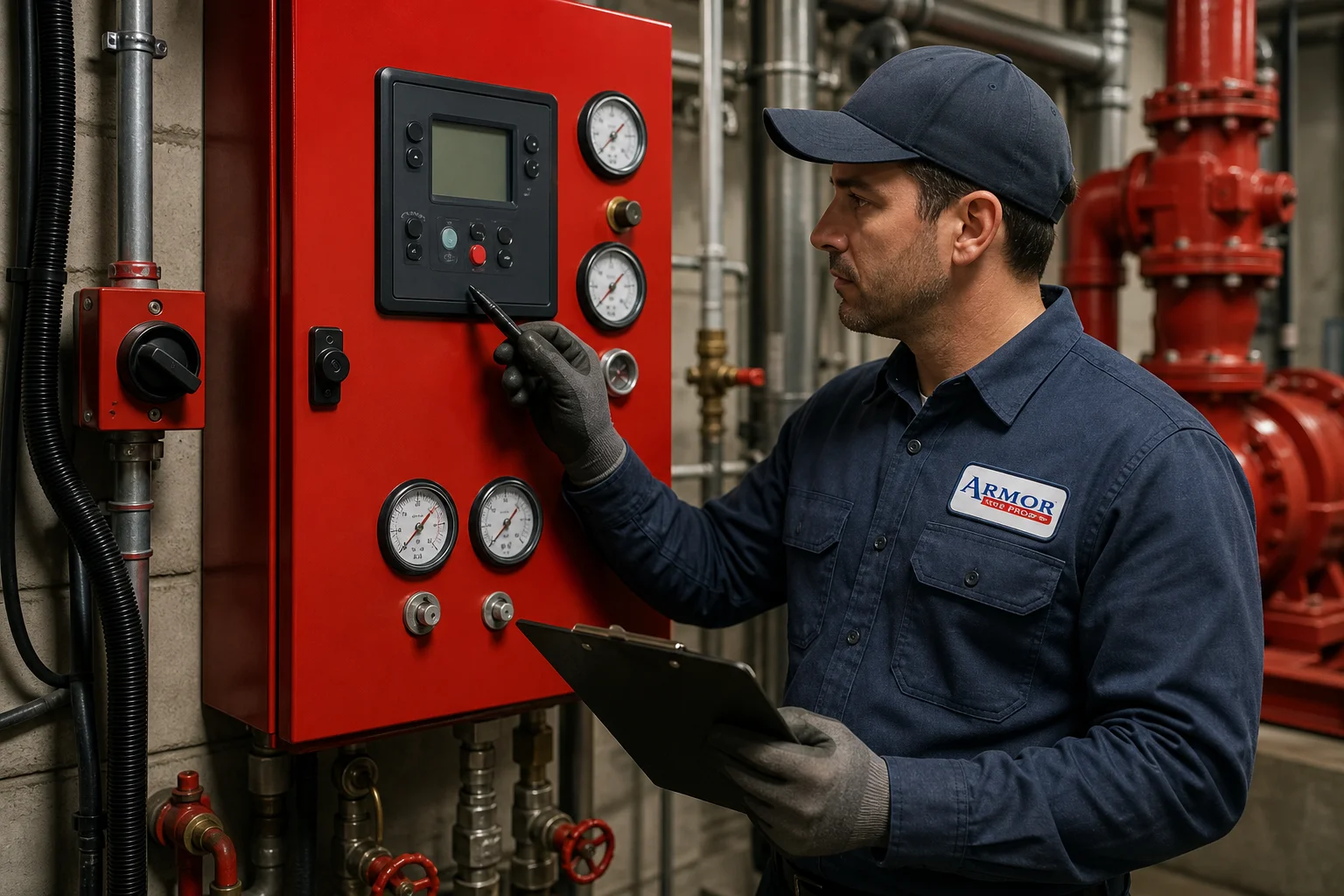
Fire protection technician performing fire pump installation in Phoenix at a commercial building

Fire Pump Systems: Selection, Installation & Maintenance for Commercial Buildings

By Blog

Commercial fire pump installation in Phoenix gives buildings with weak municipal water pressure the boosted flow their sprinklers and standpipes need to meet code during a fire. This guide covers selecting, installing, and maintaining a fire pump system that works alongside properly designed Fire Sprinklers to protect life and property.

By Armor Fire Pro Team, Fire Protection Specialists

What Is a Commercial Fire Pump System and How Does It Work?

A commercial fire pump system sits between the water supply and a building's sprinklers or standpipes, boosting pressure and flow whenever the municipal supply cannot deliver what the fire protection design requires. When a sprinkler head opens, pressure drops, a sensing line detects that drop, and the pump starts automatically to restore the flow needed to control a fire. Because a fire pump protects human life first, NFPA treats it as life safety equipment, not ordinary mechanical equipment. Fire pumps are sized around hydraulic calculations, not guesswork, so each one matches the real fires it may need to fight.

Electric vs. Diesel-Driven Fire Pumps

Fire pumps run on either an electric motor or a diesel engine. Electric-driven pumps are quieter and simpler to maintain, and work well with a reliable utility feed. Diesel-driven pumps carry their own fuel and start on battery power, so they keep running through a utility outage, which is why buildings that cannot risk losing fire protection often choose diesel. Either type must be listed for fire pump service and installed to NFPA 20.

How Do You Choose the Right Fire Pump for a Commercial Building?

Selecting a fire pump starts with a hydraulic calculation comparing the water supply at the property against the flow and pressure the sprinkler or standpipe design needs. A fire protection engineer measures static and residual pressure, factors in elevation and pipe friction loss, then sizes a pump rated in gallons per minute and pounds per square inch to close that gap. Undersizing leaves a building without enough water where it matters most; oversizing wastes budget and can damage piping.

Does Every Commercial Building Need a Fire Pump?

Not every commercial building needs one. A fire pump is only required when the municipal water supply cannot, on its own, deliver the pressure and flow the design calls for. Many single-story retail and light commercial buildings in Phoenix sit on a water main with enough natural pressure to meet demand. Taller buildings, large warehouses, and high-hazard occupancies like commercial kitchens usually do need one. The hydraulic calculation, reviewed by the local authorities having jurisdiction, settles the question for a given site.

What NFPA 20 Code Requirements Apply to Fire Pump Installation in Phoenix?

Meeting NFPA 20 fire pump requirements in Phoenix starts with a licensed, listed installation, not just paperwork. NFPA 20, the Standard for the Installation of Stationary Pumps for Fire Protection, governs how a fire pump is selected, installed, and tested. It sets requirements for the pump room: fire-rated construction, freeze protection, ventilation that supplies combustion air and vents engine heat, drainage for test water, emergency lighting, and heat and smoke detection, plus listed and labeled pump, controller, and driver assemblies. In Phoenix, the Phoenix Fire Department, alongside neighboring Valley fire agencies, checks plans against NFPA 20 and the broader Arizona fire code compliance requirements before issuing a permit, and again during an official acceptance test.

Fire protection technician performing fire pump installation in Phoenix at a commercial mechanical room

Fire Pump Installation in Phoenix: Cost, Timeline, and Licensing

What Does Commercial Fire Pump Installation Cost in Phoenix?

Cost depends on the pump's flow rating, whether the driver is electric or diesel, the pump room construction, and how much fire protection piping already exists on site. A retrofit into an older building without a dedicated pump room typically costs more than new construction, where the room and piping are planned in from the start. Armor Fire Pro prices each building after reviewing its hydraulic calculation, and a Free Quote is the fastest way to get real numbers.

How Long Does Fire Pump Installation Take From Permit to Inspection?

Timeline varies with permit review load and how quickly equipment can be procured, since pumps and controllers are often built to order. Design, permitting, equipment lead time, installation, and the final acceptance test typically run several weeks to a few months from first visit to passed inspection.

Who Is Licensed to Install and Service Fire Pumps in Phoenix, Arizona?

Arizona requires fire pump installation and service to be performed by a contractor holding the appropriate Arizona Registrar of Contractors fire protection license, with techs certified in fire pump systems where the scope calls for it. The Phoenix Fire Department confirms licensing at plan review and again at acceptance testing, and property management teams overseeing multiple sites benefit from keeping that process with one contractor.

How Often Should a Fire Pump Be Inspected, Maintained, and Tested?

NFPA 25, the standard for inspecting, testing, and maintaining water-based fire protection systems, sets the schedule a fire pump has to follow. A no-flow churn test confirms the pump starts and runs correctly: electric-driven pumps are typically tested monthly, while diesel-driven pumps are usually run weekly to keep the engine and fuel system ready. NFPA 25 also calls for an annual flow test that verifies the pump still delivers its rated pressure and flow while the building stays live and occupied. These tests run alongside the same annual inspections and certification requirements that apply to the rest of a building's fire protection systems, so most owners schedule everything on one visit. Every test has to be logged in a written record, and a documented service history protects an owner if a pump's performance is ever questioned after a loss. Newer controllers often log run time and pressure data automatically, making a decline easier to catch.

Frequently Asked Questions

How much does it cost to install a fire pump in a commercial building in Phoenix?
Cost depends on the pump's flow rating, driver type, pump room construction, and whether the piping already exists on site. New construction with the room planned from the start typically costs less than retrofitting an older building, so requesting a quote is the fastest way to get an accurate number.

How long does fire pump installation take?
Timeline depends on permit review time and how quickly the pump and controller can be manufactured, since equipment is often built to order, with design through acceptance testing typically taking several weeks to a few months.

Does every commercial building need a fire pump?
No. A fire pump is only required when the municipal water supply cannot deliver the pressure and flow the sprinkler or standpipe design calls for on its own. A hydraulic calculation, reviewed by the authority having jurisdiction, determines whether a specific building needs one.

What's the difference between an electric and a diesel-driven fire pump?
An electric-driven fire pump runs off utility power and is quieter and simpler to maintain. A diesel-driven fire pump carries its own fuel and starts on battery power, so it keeps running during a utility outage, which is why buildings without reliable dual power feeds often choose diesel.

How often does NFPA require fire pump testing?
NFPA 25 calls for a no-flow churn test, usually weekly for diesel-driven pumps and monthly for electric-driven pumps, plus an annual flow test that verifies the pump still delivers its rated pressure and flow. Skipping these tests is a common inspection finding, and results have to be logged in a written record.

Get a Fire Pump Installation Quote From Armor Fire Pro

Armor Fire Pro designs, installs, and maintains fire pump systems for commercial buildings across Phoenix, backed by licensed technicians who handle the NFPA 20 paperwork and testing from day one. Reach out today to see how our full range of fire protection services can keep your building's water supply ready when it matters most.

Fire protection technician servicing a commercial hood suppression system in a Phoenix restaurant kitchen

What a Commercial Hood Suppression System Costs in the Phoenix Metro: 9 Price Drivers

By Blog

What a commercial hood suppression system costs in the Phoenix metro depends on hood count, chemical type, and how your kitchen is built, not a flat rate. A single-hood UL 300 wet chemical setup costs less than a multi-hood line with a walk-in fryer battery. Here is what actually drives your Kitchen Fire Suppression quote up or down.

By Armor Fire Pro Team, Fire Protection Specialists

Every quote for a kitchen hood suppression system is built from the same handful of line items, whether you are outfitting a single food truck window or protecting a five-hood line against grease fires in a strip-mall restaurant. Equipment costs cover the cylinders, nozzles, detection line, manual pull station, and the fusible links or heat sensors that trigger discharge. Engineering and design costs cover the drawings a licensed fire protection engineer produces to match your exact hood, exhaust duct, and cooking equipment layout, since no two kitchens route ductwork the same way. Labor covers mounting the tank, running the mechanical gas shutoff to the cooking line, and tying the system into your building's fire alarm panel. Permit and plan review fees are set by the jurisdiction, not by us. Pricing each piece on its own, instead of asking for one flat number, is what actually explains why hood count, chemical agent, and building age move the total more than anything else stays fixed.

What Factors Drive the Price of a Hood Suppression System Installation Up or Down

A handful of variables move hood suppression system pricing more than anything else. Hood and nozzle count matter most, since each hood needs its own set of nozzles sized to the cooking equipment underneath it, a charbroiler needs different nozzle placement than a standard fryer battery. Duct length and configuration matter too: a straight exhaust duct run to the roof costs less to protect than duct that snakes through a false ceiling or a shared chase. The chemical agent you need, almost always wet chemical for standard cooking equipment and occasionally a dry chemical or specialty agent for solid fuel cooking, changes both the equipment and the ongoing service plan. Building age plays a role too, since older construction often means asbestos testing, structural bracing, or electrical upgrades before the system can go in. Whether the job is new construction or a retrofit also changes labor scheduling and access costs, covered next.

How Much Does a UL 300 Wet Chemical System Cost Per Hood in Phoenix

Nearly every commercial kitchen suppression system installed in the Phoenix metro today is UL 300 wet chemical, the standard built for the higher grease-fire temperatures modern high-efficiency fryers produce. Ansul is the brand most Valley kitchens already have, and per-hood pricing scales with nozzle count and appliance type rather than hood count alone, since a hood covering a fryer, a griddle, and a charbroiler needs more nozzles than a hood over a single fryer battery. For standard cooking equipment, wet chemical versus dry chemical suppression is rarely a real choice: wet chemical is what UL 300 and most Arizona fire codes require, so the number that actually moves is agent volume, cylinder size, and nozzle count per hood, not the type of chemical itself.

New Restaurant Build vs. Retrofit Installation Cost

Installing a hood suppression system during new construction almost always costs less than adding one after the hood, duct, and finished ceilings are already in place. On a new build, the fire protection contractor coordinates directly with the mechanical contractor before drywall goes up, so cylinder mounting, detection line runs, and the gas shutoff tie-in happen while everything is still open and accessible. A retrofit into a kitchen that is already installed and already cooking is a different job: it usually means cutting into finished ceilings, rerouting conduit around existing duct, and scheduling labor after close so the kitchen does not lose a service day. That access difference, not the equipment itself, is what makes retrofitting more expensive than building suppression in from day one.

Does Phoenix Fire Code or Insurance Requirements Change the Price

Yes, in two separate ways. Phoenix, Scottsdale, Tempe, and Mesa all adopt NFPA 96 and NFPA 17A through the International Fire Code, and the local authority having jurisdiction reviews your plans before permitting installation, which adds a plan review fee and can add engineering revisions if your first submittal is not fully compliant. Insurance carriers layer a second set of requirements on top: many require a monitored connection to a central station so a discharge signals immediately, and some require more frequent inspection than code alone calls for on higher-risk cooking lines like solid fuel cooking. Ask your carrier directly what they require before you request quotes, since a system that is compliant with fire code but not with your policy can still leave you out of compliance at renewal.

Ongoing Inspection, Monitoring, and Maintenance Costs After Installation

A kitchen hood suppression system is not a one-time purchase. NFPA 96 requires semi-annual inspections, twice a year, performed by a certified technician who tests the detection line, checks cylinder pressure, inspects nozzles for grease blockage, and confirms the manual pull station and gas shutoff still function. Monitoring is usually the smaller line: signal reporting typically rides on the same central station account already watching your Fire Alarms & Lights system, so adding hood suppression signal reporting rarely means a second monthly bill, just an added device on an existing 24/7 monitored line. Certification and annual inspection requirements also cover the hood and duct cleaning your insurance and fire marshal expect between suppression service visits, since a grease-caked duct undermines the suppression system even when the cylinders themselves are fully charged. How much this costs per month depends mainly on how many systems you are servicing on one visit and whether you bundle suppression, alarm, and extinguisher service into a single technician trip, usually cheaper than three separate vendors on three separate schedules.

Fire protection technician inspecting kitchen hood suppression system nozzles above a commercial cooking line

What It Costs to Recharge a System After It Discharges

When a hood suppression system discharges, whether from an actual fire or an accidental trip, it has to be fully recharged before the kitchen can legally cook again. Recharge covers refilling or replacing the wet chemical agent cylinders, replacing any fusible links or heat detectors that triggered, resetting the mechanical gas valve, and pressure-testing the system before recertification. Because a discharge also coats the hood, filters, and upper duct in wet chemical agent, most kitchens need a hood and duct cleaning immediately afterward, and some jurisdictions will not sign off on reopening until both are done. Ask whether your service provider treats recharge as part of a maintenance plan or bills it separately after a discharge, since that answer changes what an emergency actually costs you.

Permits for Hood Suppression Installation in Phoenix

Yes. Every city in the Phoenix metro requires a permit for kitchen hood suppression installation, pulled either by the installing fire protection contractor or the general contractor on a new build. The local fire department or building department reviews stamped engineering drawings before work starts, confirms the system meets NFPA 96 and the adopted fire code, and schedules a final inspection before you can operate. Permit timelines vary by city and by how complete your first submittal is, and a kitchen that changes its cooking equipment after the drawings are approved usually triggers a plan revision, which adds both time and cost. Locking equipment specs before your contractor submits for permit is the single biggest thing you can do to keep kitchen hood suppression installation in Phoenix on schedule.

Frequently Asked Questions

What is the average cost of a fire suppression system for a restaurant kitchen?
What a commercial hood suppression system costs in the Phoenix metro varies too much for one average number to mean much, because the total depends on hood count, nozzle count, chemical agent, duct configuration, and whether the job is new construction or a retrofit. Two kitchens with the same square footage can land on very different totals if one has a single fryer hood and the other has a five-hood line with a charbroiler and a solid fuel cooker. A site walk-through is the only way to price it accurately.

How often does a commercial hood suppression system need to be serviced or inspected?
NFPA 96 requires semi-annual service, twice a year, for most commercial kitchens, performed by a certified fire protection technician. Kitchens with heavier grease loads, like solid fuel cooking or 24/7 operations, sometimes need more frequent hood and duct cleaning between suppression service visits even though the suppression inspection itself stays on the standard twice-yearly schedule.

Do I need a permit to install a hood suppression system in Phoenix?
Yes. Every jurisdiction in the Phoenix metro requires a permit and a plan review before installation, and a final inspection before the system is approved for use. Your fire protection contractor typically pulls the permit and coordinates the inspection as part of the installation project.

What information does a contractor need to give me an accurate quote?
Bring your hood and duct layout, the make and model of your cooking equipment, hood count and length, whether the job is new construction or a retrofit, and any insurance requirements around monitoring or inspection frequency. The more of that you can hand over up front, the fewer site visits it takes to get a firm number.

Get a Straight Answer About Your Hood Suppression Quote

Every kitchen's suppression system prices out differently once hood count, chemical agent, and access are factored in, and the fastest way to get an accurate number is a site walk-through instead of a phone estimate. Get in touch for a Free Quote and we will price your kitchen hood suppression system line by line.

Certified technician performing backflow testing in Phoenix AZ on a commercial water supply line

Backflow Testing in Phoenix AZ: What It Is, Why It Matters, and When It Is Required

By Blog

Backflow testing in Phoenix AZ confirms that your property's backflow prevention device is stopping contaminated water from siphoning back into the clean water supply. The City of Phoenix requires annual testing on every installed assembly, and Armor Fire Pro's Backflow Testing team handles the inspection, testing, and paperwork so you stay compliant.

By Armor Fire Pro Team, Fire Protection Specialists

What Backflow Testing in Phoenix AZ Actually Checks

Backflow testing in Phoenix AZ is the annual inspection that verifies a backflow prevention device is doing its one job: stopping used or contaminated water from reversing direction and flowing back into the clean water supply that serves your building and your neighbors. When pressure drops on the city main during a break or a heavy demand spike, a cross connection at an irrigation line, a fire sprinkler riser, or industrial process equipment can pull chemicals, fertilizer, or stagnant water backward into the potable system. A properly installed and certified backflow prevention device closes automatically the moment flow tries to reverse, and that closure is exactly what a technician confirms during testing.

Commercial buildings, restaurants, medical facilities, apartment complexes, and any property with an irrigation system or fire suppression line typically has at least one backflow prevention device on site. If your property has never been tested, or if you are not sure where your device is located, that is the first thing a certified backflow testing visit will identify, along with whether the device is even the correct type for your water service.

How a Backflow Prevention Device Protects Your Water Supply

A backflow prevention device works through a set of internal check valves that only allow water to move in one direction. A double check valve assembly uses two independent check valves in series. If one valve fails to seat completely, the second still stops reverse flow before contaminated water reaches the local water main. A reduced pressure zone assembly adds a relief valve between the two check valves, so if either valve leaks, the relief valve opens and discharges water rather than letting it flow backward into the clean water supply.

Most commercial Fire Sprinklers systems tie directly into the domestic water supply, which is exactly why the City of Phoenix requires a dedicated backflow prevention device on every fire line, not just irrigation and process water connections. Standing water inside a sprinkler system, combined with any chemical additives used for corrosion control, is treated as a contamination risk the same as an irrigation cross connection, and it gets tested on the same annual schedule.

When Annual Backflow Testing Is Required in Phoenix

The City of Phoenix cross connection control program requires annual backflow testing on every backflow prevention device installed on a commercial, industrial, or irrigated property. The requirement applies whether the device sits on a domestic water line, a fire line, or an irrigation meter. Property owners typically receive a renewal notice from the city ahead of the due date, but the responsibility to schedule arizona backflow testing on time stays with the property owner, not the water department.

Missing the annual backflow testing deadline can result in a locked meter or a formal notice of non-compliance, since the city treats an untested device as an unverified contamination risk to the local water system. Backflow testing is one piece of a property's broader compliance calendar, alongside required inspections for fire alarms, sprinklers, and suppression systems, so it helps to track the renewal date alongside those other annual inspections rather than as a standalone deadline.

A certified fire protection technician performs backflow prevention testing on a commercial water supply line outside a Phoenix building

What Happens During a Certified Backflow Testing Appointment

A certified backflow testing appointment starts with the technician locating the device and confirming the make and model against city records. Using a calibrated differential pressure gauge, the technician isolates the assembly, then tests each check valve and, on a reduced pressure zone assembly, the relief valve, all while the device stays under normal supply pressure. Each valve has to hold within a specific pressure differential to pass, and the technician checks flow in both directions before signing off.

The technician records the test results on a standardized city form, submits a copy directly to the City of Phoenix water services department, and you receive a copy of the results for your own compliance file. If a device fails, the technician explains what part needs repair or replacement, since a failed backflow prevention device has to be corrected and retested before the city will mark the property compliant. Most straightforward tests take under an hour to perform, and no water service interruption is needed for the building beyond the isolated line.

Choosing a Certified Backflow Testing Provider in Arizona

Not every plumber or fire protection company holds current backflow tester certification, and the City of Phoenix only accepts test results submitted by a certified backflow tester on file with the water department. Armor Fire Pro's technicians hold that certification and bring years experience testing devices across restaurants, medical offices, warehouses, and multi-family properties throughout the Phoenix area, so the paperwork gets filed correctly the first time.

Working with a local provider matters too. A team that already services your fire alarm, sprinkler, and suppression systems can schedule backflow testing alongside other annual inspections, which keeps trucks off your property and cuts down on repeat scheduling. If your backflow prevention device installed years ago is due for a broader compliance check, that review often overlaps with Arizona fire code compliance requirements, and with how backflow prevention gets built into new sprinkler system installations from day one.

Frequently Asked Questions

How often is backflow testing required in Phoenix?
The City of Phoenix requires annual backflow testing on every installed backflow prevention device, whether it protects a domestic water line, a fire sprinkler system, or an irrigation meter. The city mails a renewal notice, but scheduling the test on time is the property owner's responsibility, not the water department's.

Who can perform certified backflow testing in Arizona?
Only a certified backflow tester on file with the local water department can perform testing the City of Phoenix will accept. Armor Fire Pro's technicians hold current certification and submit test results directly to the city on your behalf, then send you a copy for your records.

What happens if my backflow prevention device fails testing?
The technician documents which valve failed to hold pressure, recommends the repair or replacement needed, and retests the device once the work is complete. The city will not mark a property compliant until a passing test result is on file with the water department.

Do I need a backflow prevention device on my fire sprinkler system?
Yes. Any fire sprinkler system connected to the domestic water supply needs its own backflow prevention device, and that device is subject to the same annual backflow testing requirement as irrigation or process water connections on the property.

Will I receive a copy of my test results?
Yes. After the technician submits results to the City of Phoenix, you receive a copy of the results for your own records, which you should keep alongside your other fire and water compliance documentation for future inspections.

Schedule Your Backflow Testing in Phoenix AZ Today

A backflow prevention device only protects your water supply if it is tested and documented every year, and Armor Fire Pro's certified technicians handle the testing, paperwork, and city submission in one visit. Request a Free Quote to get your property scheduled before your next renewal notice arrives.

Fire protection specialist performing an NFPA 96 hood system inspection on a commercial kitchen rooftop

NFPA 96 Hood System Inspection Intervals for Commercial Kitchens (And What a Failed Inspection Costs)

By Blog

NFPA 96 hood system inspection intervals for commercial kitchens range from monthly to annual depending on how much grease your equipment produces, and a failed inspection can cost far more than the cleaning bill itself, from a fire marshal shutdown to a denied insurance claim tied to your Kitchen Fire Suppression system. Here's the schedule, and the fallout.

By Armor Fire Pro Team, Fire Protection Specialists

How Often Does NFPA 96 Require Hood System Inspection Intervals for Commercial Kitchens?

NFPA 96 hood system inspection intervals for commercial kitchens aren't one-size-fits-all. The standard sorts every kitchen into a cooking volume tier, and that tier sets how often a technician inspects and cleans the exhaust hood, ductwork, and fan. Kitchens that cook around the clock or run solid fuel equipment like charcoal or wood-fired grills sit on the shortest interval, monthly, while a typical full-service restaurant lands on a quarterly schedule. Lower-volume kitchens, think a church hall or a seasonal snack bar, may only need semiannual or annual service. Your local fire marshal has final say on which tier applies, so the interval on paper is a starting point until confirmed for your kitchen.

What Determines Whether You're Quarterly, Semiannual, or Annual

Hood cleaning frequency depends on cooking volume, not restaurant size. A kitchen frying and grilling twelve or more hours a day produces far more grease vapor than one running a light lunch menu three days a week, and that volume is what a contractor measures before assigning your interval. Solid fuel cooking produces sticky, harder-to-remove residue than a typical fryer line, which is why those systems usually get bumped to monthly regardless of covers served. High-volume kitchens rarely qualify for anything longer than quarterly. If your cooking style changed since your last inspection, say you added a wok station or a charbroiler, flag it, since it can shorten your interval.

What Happens During an NFPA 96 Hood System Inspection?

A real inspection covers the whole exhaust path, not just the visible hood panels. A qualified technician checks grease buildup inside the hood, ductwork, and rooftop fan, confirms access panels are actually accessible instead of painted or bolted shut, and verifies the fan and ductwork are structurally sound enough to help control a fire if grease ignites inside the system. A complete visit typically also confirms your Fire Extinguishers & Accessories are charged, tagged, and mounted where code requires, since fire marshals commonly check both during the same walk-through. The technician also checks that the wet chemical suppression system has full nozzle coverage and a current service tag, since a blocked nozzle can't stop a fire even when the hood is spotless. Pairing that check with your wet chemical suppression systems service on the same visit avoids scheduling two contractors for one exhaust system.

Fire protection technician inspecting a commercial kitchen exhaust hood and ductwork

Who Is Qualified to Perform NFPA 96 Hood Inspections and Cleanings?

Hood cleaning and inspection work should go to a trained fire protection contractor familiar with NFPA 96, not general janitorial staff. The job requires knowing where grease hides inside ductwork, how to safely access a rooftop fan, and what actually satisfies the standard versus what just looks clean from the floor. Many technicians carry certification through IKECA, the trade association built around kitchen exhaust cleaning, and a documented service tag left after each visit is what proves the work happened if a fire marshal or adjuster ever asks.

Who Enforces These Requirements in Your Kitchen

The local fire marshal, acting as the authority having jurisdiction, actually enforces NFPA 96 in a commercial kitchen. NFPA 96 itself is a set of guidelines until a city or county adopts it into local fire code, at which point following it stops being optional. That adoption is why fire protection for commercial kitchens looks the same on paper nationwide but gets enforced locally, through the same fire code requirements that govern the rest of your building's fire protection systems and the same fire marshal who signs off on your occupancy.

What Does It Cost When a Commercial Kitchen Fails a Hood Inspection?

The real cost isn't one number, it's a stack of line items that shows up after the fact: a corrective cleaning to bring the system up to code, a re-inspection fee to get the fire marshal back out, and if the failure forces an unplanned shutdown, a rush service premium. Damage like a warped filter, a fan that won't spin freely, or a misaligned suppression nozzle adds repair labor on top.

A few factors move that total more than anything else. Hood count and linear footage of ductwork is the biggest driver, since labor scales with how much surface a technician has to scrape. How overdue the cleaning is matters almost as much: a kitchen cleaned two years late has hardened grease layers needing multiple passes, versus a light job for one cleaned six months late. Roof access matters too, a fan needing a ladder or lift adds time a ground-level unit doesn't. And cooking type matters: solid fuel and high-volume operations build tar-like residue that takes longer to strip than a standard fryer line.

Hood cleaning and fire suppression service are commonly billed as separate line items even though an AHJ often checks both on the same visit, so ask directly whether a quote covers just the hood or the full protection scope. A few questions get an accurate number: how many hoods and duct run, what's cooked and how often, when was the system last serviced, and does roof access need special equipment. Give a contractor those details, plus your last service date, and understanding your NFPA 96 interval before asking for a quote keeps the number honest instead of generic.

What Are the Consequences of Failing an NFPA 96 Inspection Beyond the Cleaning Bill?

A failed hood inspection is a life safety finding, not a paperwork issue, and the fire marshal treats it that way. Beyond corrective service, a kitchen can face a formal notice of violation, a set deadline to fix the problem, and in serious cases, an order to stop cooking on that line until it passes re-inspection. Repeat failures draw closer scrutiny on future visits, and some jurisdictions escalate to fines.

What Happens Immediately After a Restaurant Fails a Hood Inspection

Expect a written notice describing exactly what didn't pass, grease buildup, a blocked access panel, or a suppression system out of service, along with a correction window, often measured in days rather than weeks. If the suppression system itself is non-functional, some fire marshals order the cooking line shut down immediately, since an unmanaged fire can spread fast without a working system to contain it. Getting a contractor scheduled the same day is usually the fastest way to reopen the line.

Will Insurance Pay for a Kitchen Fire If Hood Inspections Were Skipped?

It depends on the policy, worth confirming directly with your carrier rather than assuming either way. Many commercial property and liability policies for restaurants include maintenance language expecting documented, code-compliant upkeep of fire protection systems, hood cleaning included. If an insurer can show a fire started or spread because scheduled hood cleaning or suppression service was skipped, that clause can become grounds to deny or reduce a claim. Keeping every service tag, invoice, and inspection report on file is what lets a kitchen prove compliance if a claim is ever challenged.

Frequently Asked Questions

How long does an NFPA 96 hood inspection take?
Most inspections for a single hood system run one to a few hours, depending on how many hoods are involved and how much grease has built up since the last visit.

Can a commercial kitchen stay open with a failed hood inspection?
Sometimes. If the hood is dirty but the fire suppression system is still functional and access isn't blocked, many fire marshals allow the kitchen to keep operating during a short correction window. If the suppression system itself is out of service, or the violation is severe, the AHJ can order the cooking line closed until a passing re-inspection is completed.

Does NFPA 96 apply to wood or charcoal cooking equipment?
Yes. Solid fuel operations like wood-fired ovens, charcoal grills, and char-broilers fall under NFPA 96 and typically need the shortest cleaning interval of any kitchen type, often monthly, because solid fuel cooking produces heavier, harder-to-remove grease and tar deposits than standard fryers or flat-top grills.

What's the difference between hood cleaning and a hood inspection?
Hood cleaning removes grease from the hood, ductwork, and fan. An inspection is broader: it checks whether the whole exhaust and fire protection system, cleaning included, still meets NFPA 96 and local fire code.

Who keeps the compliance records after each hood service visit?
The kitchen owner or manager is ultimately responsible for keeping service tags, invoices, and inspection reports on file, even though the contractor typically leaves documentation behind at every visit. Those records are what a fire marshal or adjuster will ask to see first if compliance is ever questioned.

Get Your Kitchen on a Compliant Inspection Schedule

Skipping or guessing at your NFPA 96 hood system inspection intervals for commercial kitchens is the expensive way to find out where your kitchen actually falls. Request a Free Quote or contact Armor Fire Pro Team directly, and our fire protection services will confirm your cooking volume, your current schedule, and exactly what a compliant visit covers before the fire marshal has to.

Fire protection technician inspecting a dry fire sprinkler system valve in a cold storage warehouse

Dry Fire Sprinkler Systems: Cold Storage & Freeze-Protected Solutions

By Blog

Dry fire sprinkler systems protect cold storage facilities, unheated warehouses, and parking structures where standing water would freeze and burst pipes long before a fire ever started. By holding back water with pressurized air until heat triggers activation, these systems deliver dependable Fire Sprinklers coverage in freezing environments across the Phoenix area.

By Armor Fire Pro Team, Fire Protection Specialists

Why Dry Fire Sprinkler Systems Matter for Freeze-Prone Buildings

A standard wet pipe sprinkler system keeps water sitting inside the pipes at all times, ready to discharge the instant a sprinkler head activates. That design works fine in heated office space, but it fails in cold storage. Water left in a pipe network at sub-freezing temperatures expands, cracks fittings, and can rupture an entire branch line before a fire ever gets detected. Dry fire sprinkler systems solve that problem by removing standing water from the equation entirely.

Building owners who operate freezers, refrigerated warehouses, unheated loading docks, or exposed parking garages need a sprinkler system engineered for those conditions. Arizona's climate rarely produces freeze events outdoors, but commercial refrigeration units and cold storage rooms create the same risk indoors year round. A dry sprinkler system is the code compliant answer, and it remains one of the most reliable forms of fire protection available for these spaces.

The Mechanics Behind Pressurized Air and Water Flow Delivery

Instead of water, a dry pipe system fills its pipe network with pressurized air nitrogen that holds a dry pipe valve closed at the system riser. Water sits behind that valve, staged and ready, but it never enters the overhead piping until the system actually needs to discharge.

When heat from a fire opens a sprinkler head, the pressurized air escapes through that open head and pressure inside the pipe drops. Once pressure falls below the threshold the dry pipe valve is calibrated to hold, the valve trips open and water flow begins moving through the pipes toward the open head. This sequence adds a short delay compared to a wet system, but it is the tradeoff that keeps a dry sprinkler system from freezing solid in cold areas.

Many contractors now fill the pipe network with nitrogen instead of ordinary compressed air. Air nitrogen reduces the oxygen available inside the pipe, which slows internal corrosion and extends the service life of both the piping and the dry pipe valve itself.

dry fire sprinkler system pipe network with a technician checking a dry pipe valve in a cold storage warehouse

Where Freeze-Protected Sprinkler Systems Are Required

Cold storage warehouses, refrigerated distribution centers, unheated attics, parking structures, and loading docks are the areas where a dry sprinkler system is typically required rather than optional. The National Fire Protection Association addresses these installations directly in NFPA 13, the standard that governs sprinkler system design. Arizona layers its own construction requirements on top of that federal standard, and meeting them starts with understanding the fire code compliance requirements that apply before a project moves forward.

If you are unsure whether your building's cold storage areas already meet current code, our Services team can walk the site and confirm what's required. A full installation follows its own sequence from design through final inspection, and our sprinkler installation process covers what to expect at each stage for a commercial building.

Dry Pipe Valve Operation and Maintenance Considerations

A dry pipe valve is a mechanical device, and like any mechanical device it needs regular attention. NFPA 25 requires an annual full trip test to confirm the valve opens correctly and water reaches the system within the expected time. Air pressure inside the pipe network also needs routine monitoring, since a slow leak can drop pressure enough to cause an unintended trip or, worse, leave the system unable to hold air at all.

Building owners should also watch for corrosion inside older dry pipe systems that still run on compressed air rather than nitrogen. Trapped moisture in humid air is the main driver of internal pipe corrosion, which is why more fire protection contractors now recommend nitrogen generators for facilities that depend on long term reliability. Pairing this maintenance with routine checks on your building's fire alarm and detection equipment keeps detection and suppression working together instead of as separate systems.

Comparing Dry Sprinkler Systems to Wet Pipe Alternatives

Wet pipe sprinkler systems are simpler, less expensive to install, and respond faster because water is already in the pipe. For any heated commercial space, a wet system is usually the right call. But once temperatures in a building or storage area can drop to freezing, even briefly, a wet system becomes a liability rather than protection.

Dry sprinkler systems trade a small amount of response time for freeze resistance. That tradeoff is well worth it in cold storage, unheated warehouses, and any exposed structure where control over temperature isn't guaranteed. Some facilities also pair sprinkler protection with a broader safety plan that ties detection, suppression, and emergency response together instead of running them as separate systems. Smoke and heat detectors provide early warning to occupants and monitoring services, while the sprinkler system provides the active suppression once heat reaches a sprinkler head. Coordinating how these systems work together is worth raising with your fire protection contractor when a cold storage building is being designed or upgraded.

Frequently Asked Questions

What is the difference between a dry fire sprinkler system and a wet system?
A wet system keeps water in the pipes at all times, ready for immediate discharge. A dry fire sprinkler system holds pressurized air in the pipe network instead, with water staged behind a dry pipe valve. Water only enters the pipes after a sprinkler head activates and the valve trips open, which prevents freezing in cold areas.

Why do dry pipe systems use nitrogen instead of regular air?
Air nitrogen reduces the oxygen inside the pipe network, which slows the internal corrosion that ordinary compressed air can cause over time. Facilities that depend on long term reliability in cold storage or unheated buildings often see fewer pipe failures and valve issues after switching to a nitrogen supply.

How often does a dry pipe valve need to be tested?
NFPA 25 requires a full trip test of the dry pipe valve annually to confirm the valve operates correctly and water reaches the system within the required time. Air pressure should also be checked routinely between full trip tests to catch slow leaks before they cause a problem.

Where are dry sprinkler systems typically required?
Cold storage warehouses, refrigerated distribution space, unheated attics, parking garages, and loading docks are the most common areas where a dry sprinkler system is required. Any space where temperatures can drop to freezing, even occasionally, is a candidate for dry pipe protection under current fire code.

Is a dry fire sprinkler system slower to respond than a wet system?
Yes, slightly. Because the pipe network has to fill with water after the dry pipe valve trips, there is a brief delay compared to a wet system where water is already present. Proper design keeps that delay minimal, and the freeze protection it provides outweighs the small difference in response time.

Get a Free Quote for Your Cold Storage Fire Protection

Freeze damage takes a sprinkler system offline right when a building needs it most, and cold storage facilities can't afford that gap in protection. Request a Free Quote and Armor Fire Pro will design a dry pipe system built for your building's specific temperature risks.