
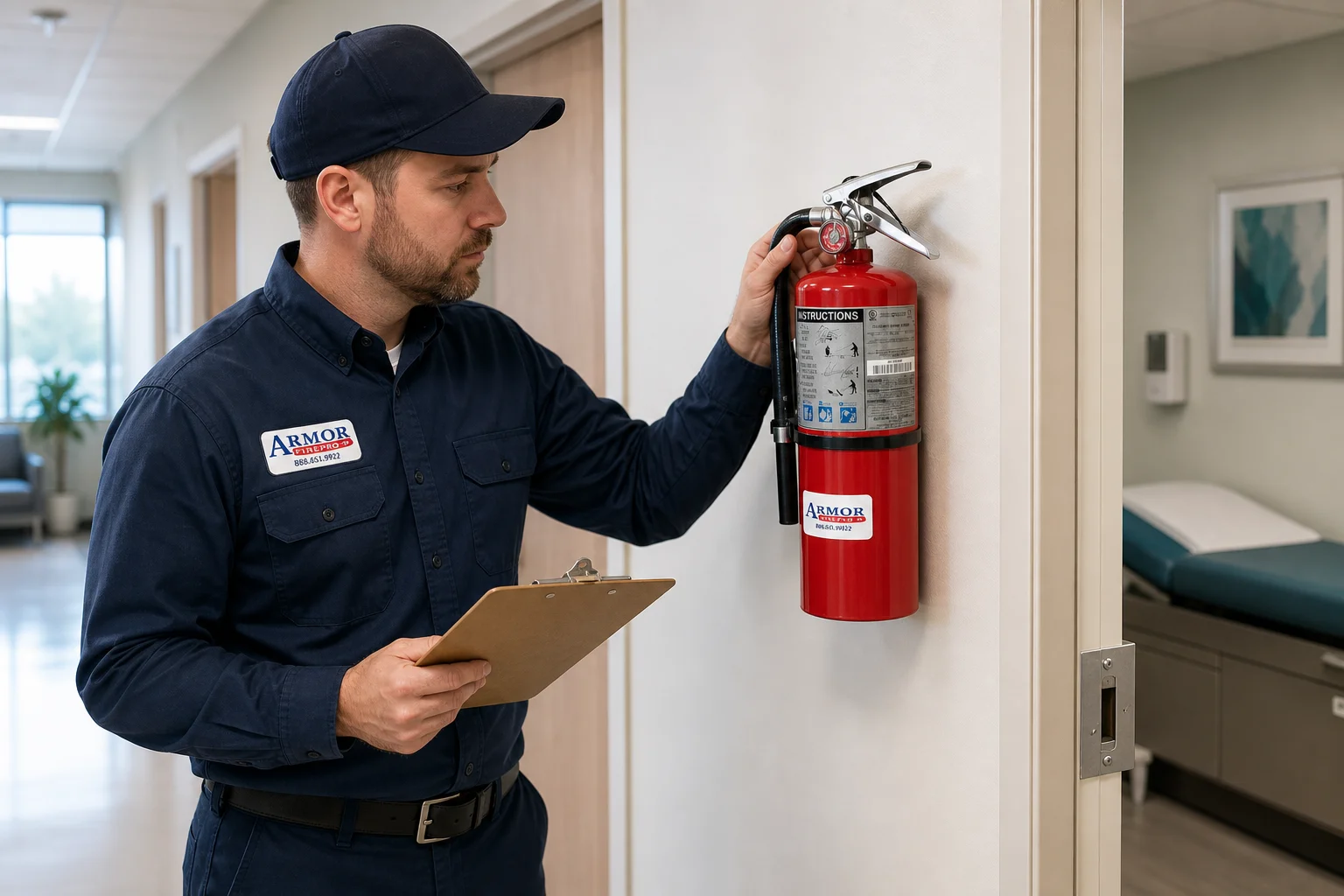
K Class vs ABC vs CO2 extinguishers each protect against a different fire hazard, and the wrong choice can damage sensitive equipment or fail outright. Medical offices, dental practices, and labs each face distinct risks, from cooking oil to sensitive electronics. The right Fire Extinguishers & Accessories match the hazard, not just the building.
By Armor Fire Pro Team, Fire Protection Specialists
How Do K Class vs ABC vs CO2 Extinguishers Differ by Hazard Type?
Every fire extinguisher is built for a specific class of fire, and mixing that up can make things worse. An ABC extinguisher uses a multi-purpose dry chemical agent effective on ordinary combustibles, flammable liquids, and energized electrical equipment, the same yellow powder mounted in most hallways and break rooms. A K Class extinguisher is different: built for cooking fires involving cooking oil and animal fat, it uses a wet chemical agent that cools the oil and forms a soapy foam layer over it. A CO2 extinguisher displaces oxygen and cools the fire while leaving no residue, making it the choice for electronics and server rooms where dry or wet chemical residue would cause more damage than the fire itself.
Choosing the Right Extinguisher for Medical, Dental, and Lab Spaces
Matching K Class vs ABC vs CO2 extinguishers to each room is less about square footage and more about what's actually inside, cooking equipment, ordinary furnishings, or sensitive electronics.
Which Fire Extinguisher Is Best for a Medical Office or Clinic?
Most medical offices and clinics are best protected by a standard ABC extinguisher placed according to NFPA 10 travel-distance rules. Exam rooms and administrative offices mainly present ordinary combustibles plus electrical risk from monitors and diagnostic devices, and one ABC extinguisher covers both. A breakroom with a stove or fryer usually needs its own K Class unit, since a cooking fire is a different hazard than an electrical fire at a nurses' station.
Do Dental Offices Need a Class K Fire Extinguisher?
Usually not, unless the practice has a breakroom with cooking equipment that can produce a grease or oil fire, like a countertop fryer or grill. A dental exam room or sterilization area doesn't typically present that hazard, so ABC coverage is generally sufficient there. The deciding factor is whether cooking oil is present anywhere in the facility.
Why Do Labs and Server Rooms Use CO2 Extinguishers Instead of ABC?
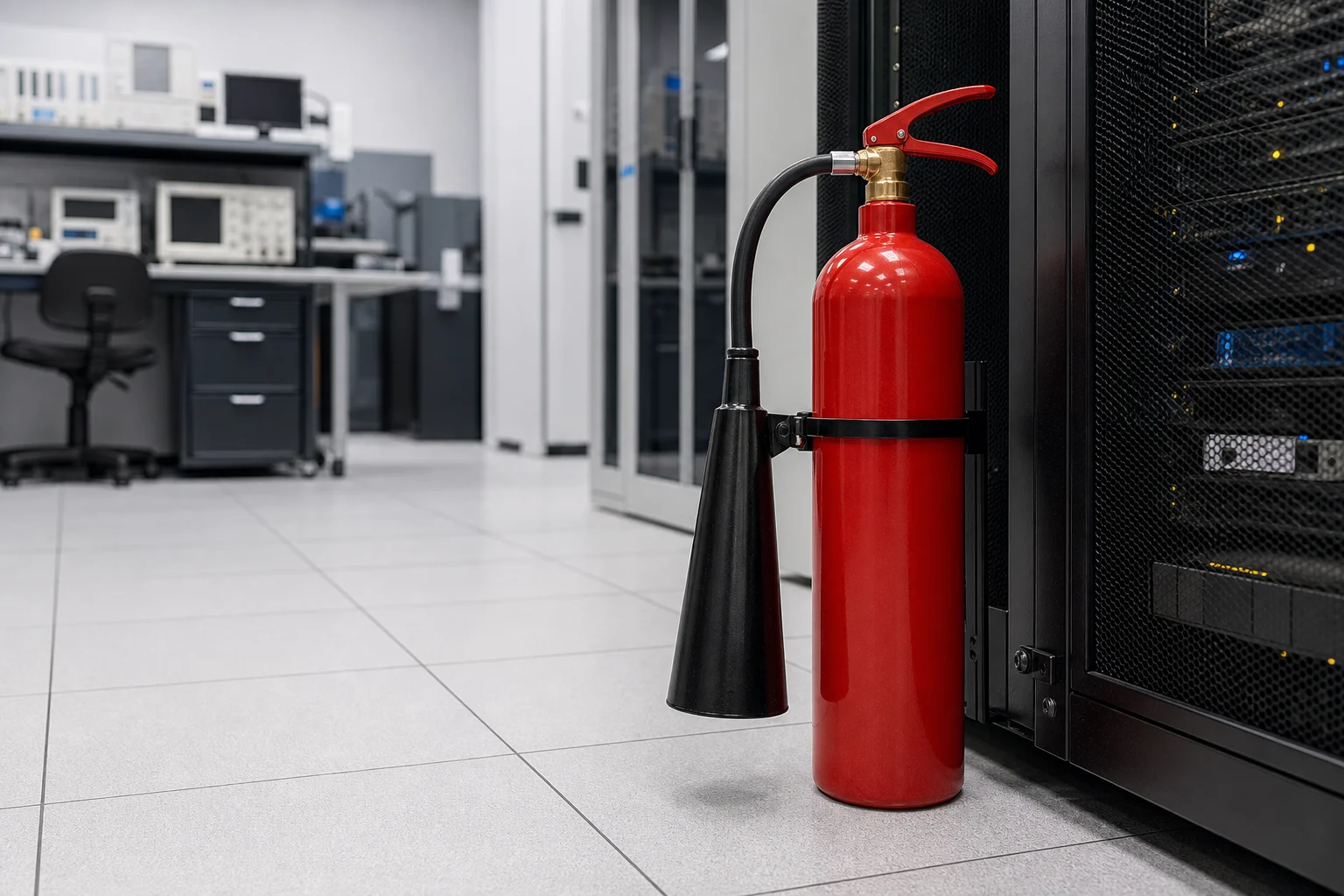
Dry chemical agents work well, but the powder is corrosive to electronics and leaves residue that can damage lab instruments and servers. A CO2 extinguisher displaces oxygen and cools the fire without depositing anything on the equipment, so labs and server closets are often equipped with CO2 alongside standard ABC coverage. CO2 is less effective on ordinary combustibles like paper, so it's a supplement, not a full replacement.
CO2 Extinguisher Safety and Composition
Is a CO2 Extinguisher Safe to Use Around Medical or Lab Equipment?
Yes, a CO2 extinguisher is generally the safest option around medical and lab equipment because it leaves no residue and won't damage electronics the way a dry chemical agent can. CO2 discharges at high pressure and extreme cold, so avoid direct contact with the horn; discharging in a small enclosed room can temporarily reduce oxygen levels. Ventilate a confined lab or server closet after use, even though the agent itself isn't toxic.
What's Inside a CO2 Extinguisher and Why Does It Leave No Residue on Equipment?
A CO2 extinguisher holds liquid carbon dioxide stored under pressure. When discharged, it expands rapidly into a gas that forms a cooling cloud and displaces oxygen. Because carbon dioxide is a gas at room temperature, it dissipates into the air after use instead of leaving behind powder, foam, or moisture. That's why CO2 is standard near circuit boards and lab instrumentation: nothing is left to short out a connection afterward.
NFPA 10 Requirements for Healthcare Facilities
How Many and Which Types of Extinguishers Does NFPA 10 Require for Healthcare Facilities?
NFPA 10 sets minimum extinguisher placement based on occupancy hazard level and travel distance, not a flat per-square-foot number, so the count depends on a facility's layout and hazard classification. Most medical and dental offices fall under light or ordinary hazard occupancy, calling for a rated extinguisher within a set travel distance, plus supplemental Class K or CO2 units wherever cooking equipment or sensitive electronics are present. Because the requirement varies by floor plan and local code, a facility-specific placement plan beats a generic rule of thumb.
What Size Fire Extinguisher Is Required for a Dental Exam Room or Lab Space?
There's no size requirement tied to an individual exam room. NFPA 10 works off travel distance across the facility, so one properly rated hallway unit can cover several exam rooms if no point exceeds the maximum distance. A 5 lb or 10 lb ABC unit is common for these areas, with exact size depending on the hazard class assigned. Lab spaces with sensitive equipment often add a dedicated CO2 unit near the equipment, in addition to standard ABC coverage.
Handling Electrical and Grease Fire Risks in Medical and Dental Offices
What Extinguisher Should I Use for an Electrical Fire in a Dental or Medical Office?
For an active electrical fire involving energized equipment, an ABC extinguisher is rated for it, since the dry chemical agent doesn't conduct electricity back through the stream. In rooms with expensive electronics or servers, a CO2 extinguisher is often preferred since it leaves no residue. When it's safe, cut power to the equipment or circuit first, which lowers reignition risk.
Can You Use an ABC Extinguisher on a Grease or Kitchen Fire?
A small ABC extinguisher can knock down a minor grease fire, but it isn't recommended: the dry chemical can scatter burning oil, and the fire can reflash once the powder settles. A Class K extinguisher with a wet chemical agent is built for cooking oil fires, cooling the oil and forming a soapy foam layer that seals off oxygen and helps prevent reignition. Any breakroom with a stove, fryer, or grill should have a dedicated K Class unit as part of its Kitchen Fire Suppression coverage, rather than relying on the building's general ABC extinguishers. For a full commercial kitchen setup, a wet chemical suppression system designed for cooking oils provides continuous protection a handheld extinguisher can't match.
Can a K Class Extinguisher Be Used on an Electrical Fire?
No. A Class K extinguisher discharges a wet chemical agent, and water-based agents aren't rated for electrical fires because the stream can conduct electricity back to the operator. Class K units are built exclusively for cooking oil and grease fires and shouldn't be substituted for an ABC or CO2 extinguisher when electrical equipment is involved.
How Often Do Medical and Dental Offices Need Fire Extinguisher Inspections?
Fire extinguishers in a medical or dental office generally need a monthly visual check, confirming the gauge shows full pressure and the pin and seal are intact, plus an annual inspection by a licensed technician. Facilities in Arizona should also plan for periodic hydrostatic testing and, for CO2 and dry chemical units, internal maintenance on a schedule set by extinguisher type and local fire code. Healthcare facilities are inspected closely, so a current inspection tag is usually one of the first things a fire marshal checks.
Frequently Asked Questions
How many fire extinguishers does a small dental office need?
It depends on layout and hazard classification under NFPA 10, not a fixed number, since placement is based on travel distance rather than room count. Most small practices need at least one ABC extinguisher positioned so no point exceeds the maximum travel distance, plus a Class K unit if there's a breakroom with cooking equipment.
Can a CO2 extinguisher be used on a Class K fire?
No. CO2 can't cool and seal a deep-fat fire the way a Class K wet chemical agent does, and the oil can reignite once the CO2 disperses. Cooking oil and grease fires need a dedicated Class K unit; CO2 stays reserved for electrical and electronic equipment where residue is the concern.
What color is an ABC fire extinguisher label?
ABC fire extinguishers typically carry a label showing the letters A, B, and C to indicate it's rated for ordinary combustibles, flammable liquids, and electrical fires. The extinguisher body itself is usually the red commonly associated with fire equipment.
Do server rooms need special fire extinguishers?
Usually, yes. A server room's main risk is sensitive electronic equipment, so CO2 is typically preferred over ABC since it won't leave residue that can damage boards and connections. A portable CO2 unit is the typical baseline for the space.
How long does a CO2 fire extinguisher last before it needs service?
A CO2 extinguisher generally needs a hydrostatic test on a schedule set by code, and should be weighed periodically since CO2 units rely on stored weight, not a gauge, to confirm they're still charged. An annual inspection confirms a unit is within its service window.
Get the Right Fire Extinguishers for Your Medical or Dental Facility
Getting K Class vs ABC vs CO2 extinguishers matched to the actual hazards in your medical, dental, or lab space keeps a facility genuinely protected, not just code-adjacent. Request a Free Quote and we'll confirm the right extinguisher types, sizes, and placement for every room.

