
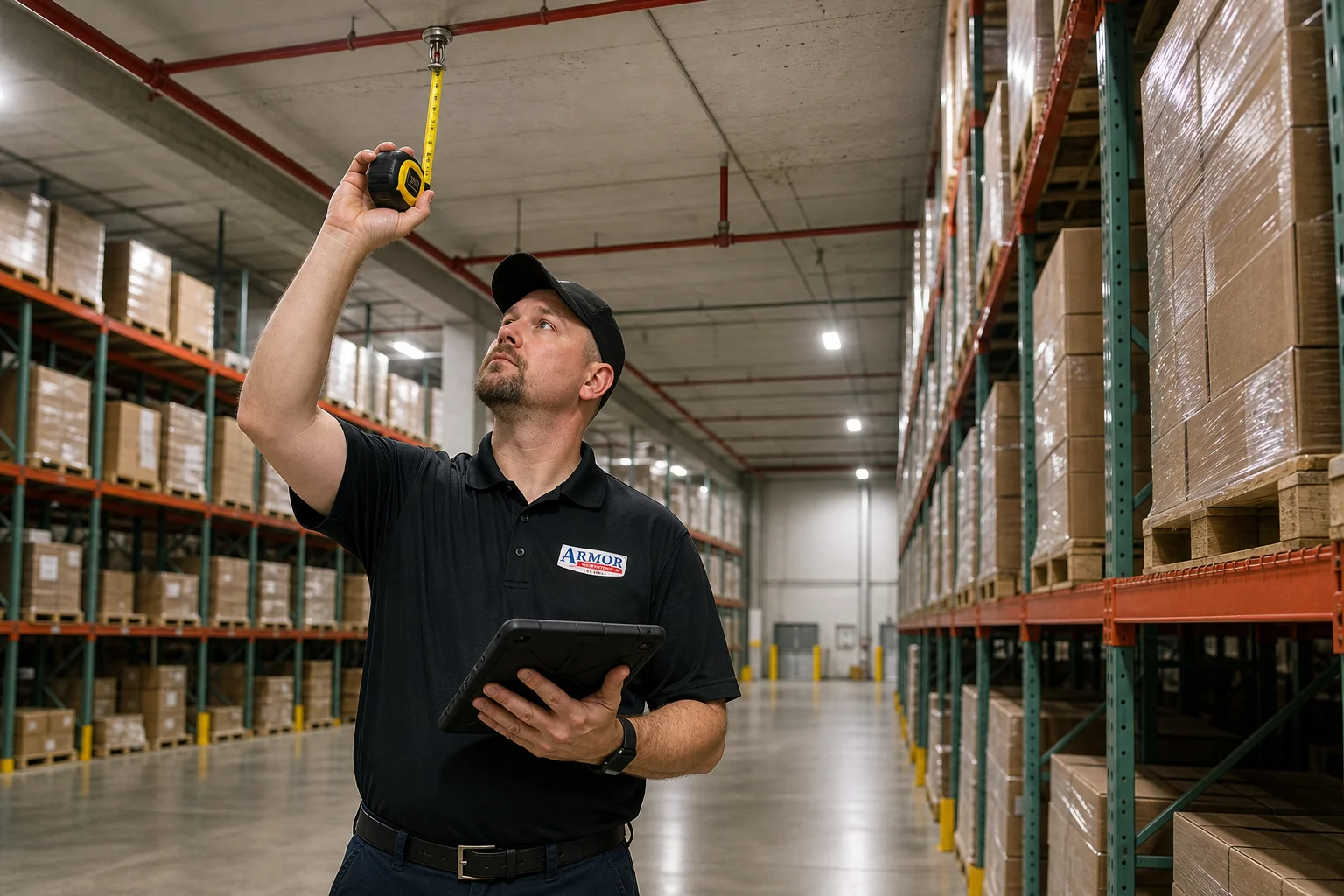
If you changed rack height or stored product in your Phoenix warehouse, your fire sprinkler system may no longer match its original design. Every Fire Sprinklers system is engineered around a specific commodity class and storage height, and moving past either one without a review can leave your building non-compliant and dangerously underprotected.
By Armor Fire Pro Team, Fire Protection Specialists
How Raising Rack Storage Height Changes Your Sprinkler System's Fire Code Requirements
When you changed rack height or stored product in your facility, you changed the fire dynamics the sprinkler design was built around. NFPA 13 calculates sprinkler density, water demand, and clearance based on a maximum storage height, a fixed ceiling height, and a defined commodity class. Add beam levels to an existing rack run and you increase both the storage height and the fuel load sitting in that space, even if the footprint of the warehouse never changes.
Any adjustment to your warehouse racking, whether taller uprights, extra beam levels, or a tighter aisle layout, reduces the clearance between the sprinkler deflector and the top of storage. Less clearance means the automatic sprinkler system has less time and less room to control a fire before it reaches the ceiling. Once storage height exceeds the number the original hydraulic calculation was based on, the system is operating outside its designed range, whether or not anyone has noticed yet.
Is a New Hydraulic Calculation Required Every Time Rack Height Increases?
Not for every minor adjustment, but in many cases, yes. A hydraulic calculation is what proves the water supply, pipe sizing, and sprinkler spacing can still deliver the required density at the new storage height. A small change within the original design's stated range may not trigger a redo. An increase that pushes past the design height, adds plastic commodities, or changes the rack layout usually does, and that determination should come from a licensed fire protection engineer or your contractor, not a guess.
What Counts as a Change in Stored Product That Can Make a Sprinkler System Non-Compliant
A sprinkler system isn't just designed around height, it's designed around commodity class. Moving from Class I-II cartoned goods to unencapsulated plastics, aerosols, or flammable liquids changes the required water density dramatically, even if the rack height and floor footprint stay exactly the same. Cartoned versus exposed plastic matters too: the same product in different packaging carries a different fire load.
Other changes that count: switching from idle pallet storage to loaded pallet racks, adding a new tenant with a different product line, introducing rubber, foam, or rolled paper, or storing product at a higher density per rack module than the original design assumed. Any of these can move a warehouse into a higher commodity class, and a system built for Class II storage will not necessarily control a fire in Class IV or plastic commodities.
How to Check If Your Sprinkler Design Still Matches After You Changed Rack Height or Stored Product
Start with the hydraulic design information sign, usually mounted near the system riser. It lists the design density, the area of application, and the commodity class and storage height the system was calculated for. Compare those numbers to what's actually on the floor today: current rack height, ceiling height, clearance, and the commodity class of the product you store.
If your current storage height, commodity class, or rack layout exceeds what's listed on that sign, the system is out of compliance, regardless of whether it was ever formally inspected against the change. A site walk paired with a Free Quote from a licensed fire protection contractor is the fastest way to get a straight answer instead of relying on a nameplate that may be twenty years old.
Who Is Responsible for Verifying Sprinkler Compliance When Storage or Tenants Change
Generally, the property owner carries ultimate responsibility for fire code compliance, even when a tenant is the one who raised rack height or brought in a different product. Lease terms can assign day-to-day responsibility to a tenant, but the fire marshal and the insurer look to the building owner first. Coordinate with your fire protection contractor and the authority having jurisdiction any time storage conditions change, whether the change was made by you or by whoever is leasing the space.
Do You Need In-Rack Sprinklers When You Increase Rack Height or Switch to Plastics
Often, yes. Ceiling-only protection, including ESFR (early suppression fast response) heads, is only rated to control specific combinations of ceiling height, storage height, and commodity class. Once rack height or product type moves past what ESFR alone can handle, in-rack sprinklers become the standard way to add suppression capacity without rebuilding the whole ceiling system.
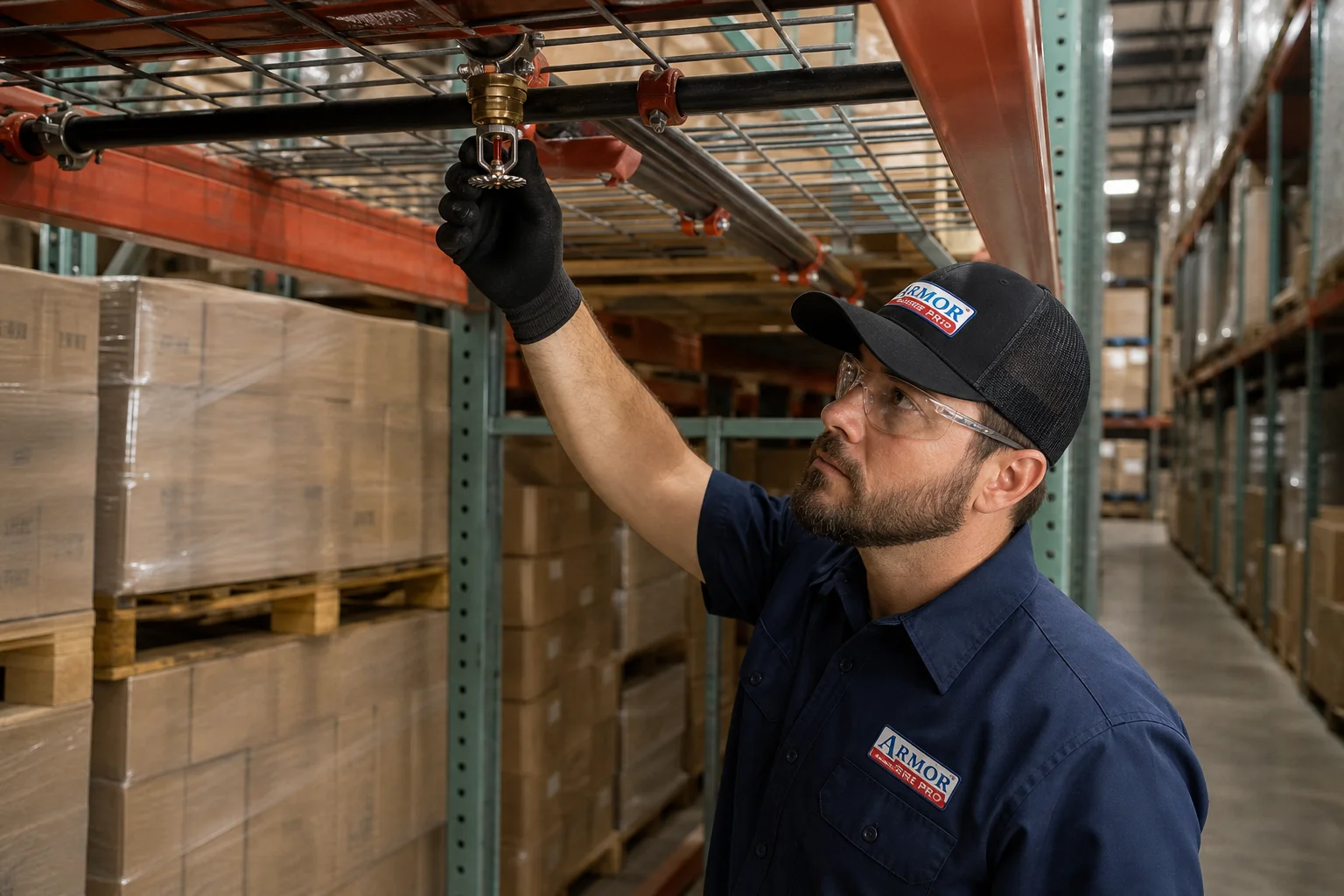
Adding in-rack sprinklers means running extra piping and heads through the rack structure itself, and it often means checking whether the water supply and fire pump can handle the added demand. For manufacturing floors and distribution centers running heavy, high-density storage, this is where a warehouse's fire protection stops being a ceiling problem and becomes a heavy-duty warehouse fire protection project that touches structural steel, extra equipment, and control valves throughout the building. Rack safety and fire code compliance become the same conversation at that scale, especially in facilities where storage modules are loaded by machine rather than by hand, since automated retrieval lines tend to push both density and fire load higher along every rack.
What Happens If a Fire Marshal or Insurance Inspector Finds Your Sprinkler System Doesn't Match Current Storage
An inspector who finds rack height, storage layout, or commodity class exceeding the system's design will typically issue a violation notice with a correction deadline. Depending on severity, that can mean a restricted certificate of occupancy, a stop-work order on new storage, or a required interim fire watch until the system is brought back into compliance.
Can a Non-Compliant Sprinkler System Void Your Commercial Property Insurance
It can, in many cases. Commercial property policies often include a protective safeguards endorsement requiring the sprinkler system to be maintained and operated as designed. If a fire loss occurs while your stored product or rack height exceeds the design the policy assumes, the insurer may have grounds to deny or reduce the claim. Review your policy language with your broker whenever storage conditions change materially, rather than assuming coverage carries over automatically.
How Much It Costs to Upgrade a Warehouse Sprinkler System for New Rack Heights or Products
Cost depends on scope, and it varies enough between buildings that a fabricated number would do you no favors. The main drivers are the hydraulic engineering and design work, the number of additional in-rack sprinkler heads and piping runs needed, whether the water supply or fire pump needs an upgrade to handle the added capacity, and local permit and plan review fees. A warehouse adding a modest range of extra beam levels to an existing pallet rack system typically needs less work than one converting an entire floor to plastics storage. The only reliable way to get a number that applies to your building is a site assessment and a written quote.
How Often a Warehouse Sprinkler System Should Be Re-Evaluated After Storage Changes
Re-evaluate any time rack height, storage layout, or commodity class changes, not on a fixed calendar. That said, routine annual system certification is also the moment to catch a change that crept in gradually, a few extra beam levels here, a new product line there, none of which triggered a standalone review on their own. Building that check into your annual testing cycle closes the gap between a storage change and the day someone notices the system no longer matches.
Frequently Asked Questions
Does adding pallet racks change my sprinkler requirements?
It can. Adding pallet racks where none existed, or adding racks that raise the overall storage height, changes the fire load and clearance the original sprinkler design assumed. Any new rack installation should be checked against the sprinkler system's design height and commodity class before product goes on the shelves, not after.
What is the difference between ESFR and in-rack sprinklers?
ESFR (early suppression fast response) heads are mounted at the ceiling and are designed to control a fire fast enough that in-rack protection isn't needed, but only within specific storage height and commodity limits. In-rack sprinklers are installed inside the rack structure itself and are typically added when storage height, density, or commodity class exceeds what ceiling-only ESFR can handle.
Do I need a permit to increase rack height in my warehouse?
Usually, yes, in most Phoenix-area jurisdictions a rack height increase past a certain threshold requires a permit review, particularly when it triggers a sprinkler system change. Requirements vary by city and by how much the height increases, so this is worth confirming with your local building or fire department before construction begins.
How long does a sprinkler system redesign take?
Timelines vary with scope, from a straightforward hydraulic recalculation to a full in-rack retrofit with new piping and a water supply upgrade. Engineering and permit review typically take longer than the physical installation itself, so building in lead time before a planned storage change avoids operating out of compliance in the interim.
Get Your Warehouse Sprinkler System Checked Before It Becomes a Violation
If you changed rack height or stored product recently and aren't certain your sprinkler system still matches, don't wait for an inspector to find it first. Our Services team can walk your facility, compare current conditions to your original design, and tell you exactly where you stand.

