
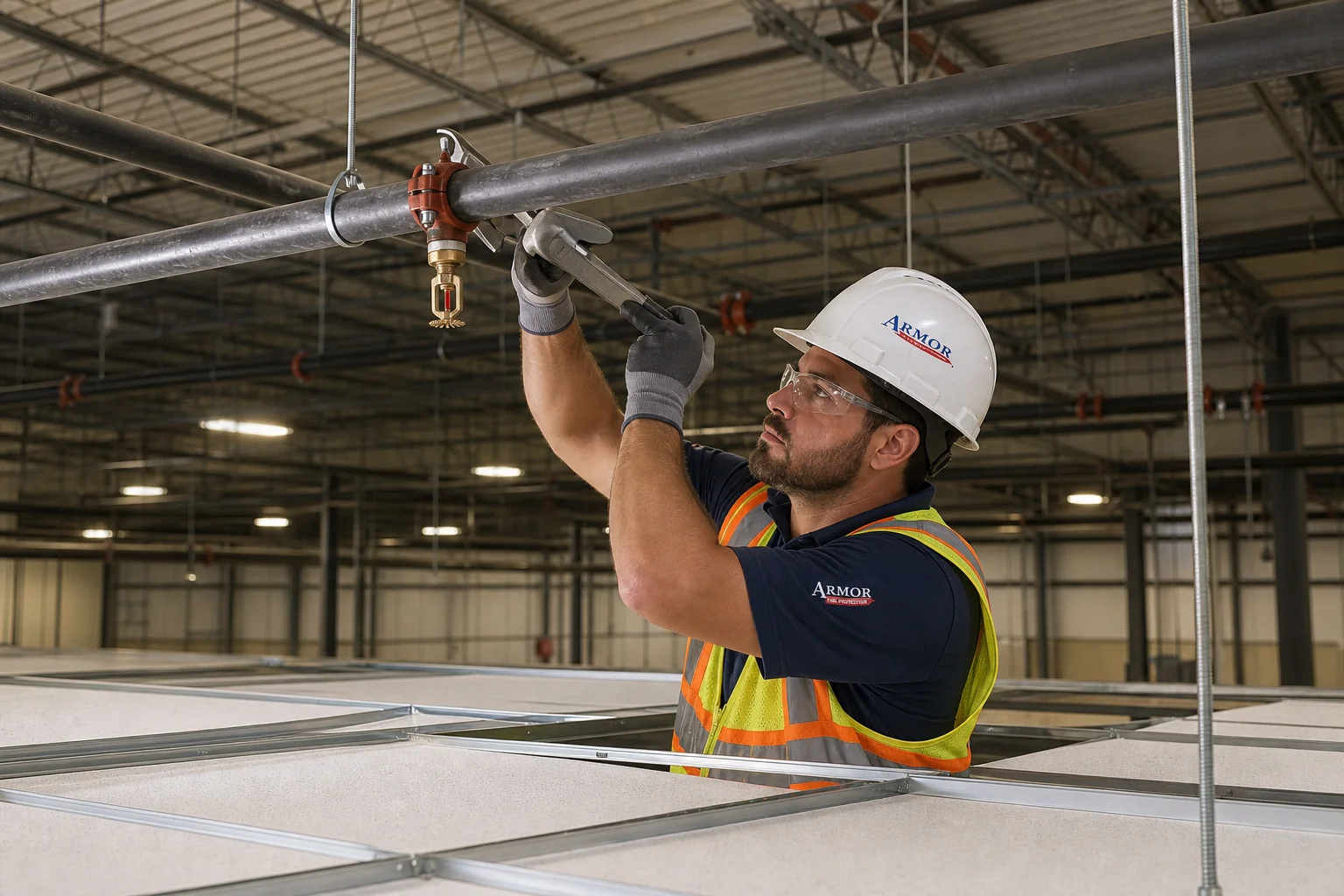
Commercial fire sprinkler installation in a Phoenix-area business typically takes 3 to 10 days on-site, with permits adding 2 to 4 weeks before work starts. Fire Sprinklers are required in most new commercial construction under Arizona's adopted fire codes, and this guide walks through every phase from design to final inspection, plus a realistic cost breakdown.
By Armor Fire Pro Team, Fire Protection Specialists
Why Fire Protection Codes Require Sprinklers in Commercial Buildings
Arizona enforces the International Fire Code alongside NFPA 13, the National Fire Protection Association's standard that governs commercial fire sprinkler systems. Most new commercial buildings over 5,000 square feet must have a fully operational fire sprinkler system in place before receiving a certificate of occupancy. Older buildings that undergo major renovations or a change of occupancy classification often face retrofit requirements under the same codes.
The Phoenix Fire Department applies these standards consistently across office complexes, warehouses, retail centers, and multi-tenant commercial spaces. Fire protection compliance is not a formality in Arizona. It is a condition of doing business.
For restaurant owners and commercial kitchen operators, Kitchen Fire Suppression systems work alongside standard sprinkler coverage because commercial cooking equipment creates concentrated heat zones that standard sprinkler heads alone are not designed to address.
The Commercial Fire Sprinkler Installation Process, Step by Step
Step 1: Site Assessment and Hydraulic System Design
A licensed fire protection engineer begins with a full site assessment. They review architectural drawings, ceiling heights, occupancy classification, and the building's water supply capacity. From that data, they produce hydraulic calculations and a sprinkler design that meets NFPA 13 specifications. The design determines pipe sizing, the number and placement of sprinkler heads, and which system type fits the building's occupancy and layout.
Skipping or compressing this step leads to undersized systems, failed inspections, and costly corrections after pipes are already inside the walls.
Step 2: Permit Submission and AHJ Approval
Design drawings go to the local authority having jurisdiction, which in Phoenix-area projects is typically the city's building and fire marshal's office. Standard permit reviews take 2 to 4 weeks. Expedited review is sometimes available for occupied buildings where delays create operational problems.
Step 3: Pipe Roughing and Sprinkler Head Installation
With permits approved, installation crews set the main supply pipe, branch lines, and sprinkler heads in accordance with the approved drawings. In most commercial buildings, this work runs above drop ceilings or through open-joist assemblies, which limits disruption to occupied tenant spaces. Each sprinkler head is positioned at the intervals specified in the hydraulic calculations.
Step 4: Hydrostatic Pressure Testing
Per NFPA 13, the completed system must hold at 200 psi for two continuous hours without leaking. A fire inspector from the authority having jurisdiction witnesses this test before any ceilings are closed. Joints, fittings, and connection points are all verified under pressure. Any failures require immediate correction and a re-test before work can proceed.
Step 5: Final Inspection and Certificate Sign-Off
After the system passes the pressure test and all deficiencies are resolved, the final inspection clears the building for occupancy. The building owner receives as-built drawings, the official inspection tag, and maintenance records. Insurance carriers for most commercial buildings require these documents as a condition of coverage.
Types of Fire Sprinkler Systems for Commercial Buildings
Wet Pipe Systems
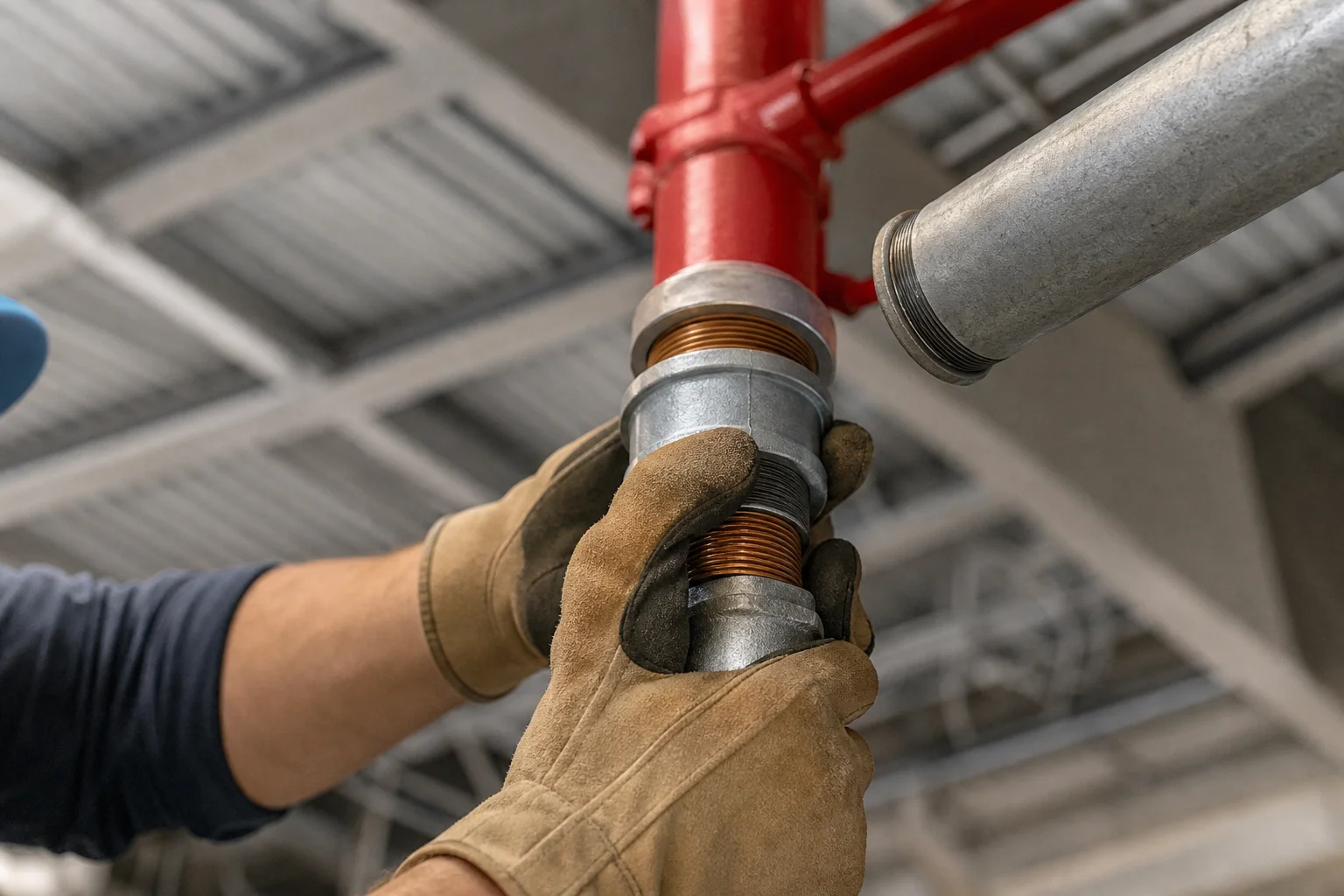
The most common type used in Phoenix commercial buildings. Water sits in the pipes continuously and releases immediately when a sprinkler head activates. Wet pipe fire sprinkler systems are the default for offices, retail spaces, and warehouses because they require the least maintenance and respond faster than any other configuration.
Dry Pipe Systems
Dry pipe systems store pressurized air or nitrogen in the pipes instead of water. When a sprinkler head opens, the air escapes and water fills the line and flows to the activated head. These systems serve areas where freezing temperatures are a concern, including parking structures and unheated storage wings.
Pre-Action Systems
Pre-action fire sprinkler systems require two separate triggers before water discharges: a signal from a fire detection device and the physical activation of a sprinkler head. Data centers and server rooms rely on pre-action systems to eliminate the risk of accidental water release onto sensitive electronics.
Deluge Systems
Deluge systems open every sprinkler head simultaneously when the system activates. They serve high-hazard environments like aircraft hangars and chemical processing facilities where fire suppression must be immediate and total across the entire protected area.
These four system types rarely work in isolation on a real building. Most Phoenix facilities combine them into a broader integrated fire protection system that also covers detection and alarm coverage.
What Commercial Fire Sprinkler Installation Costs in Arizona
Cost depends on four main factors: building square footage, system type, ceiling configuration, and local labor rates. NFPA's Fire Protection Research Foundation has published sprinkler cost benchmarks for commercial occupancies, and Phoenix-area contractor quotes generally fall within these ranges:
- New construction, wet pipe system: $1.50 to $3.00 per square foot for standard commercial occupancies
- Retrofit into existing construction: $2.00 to $7.00 per square foot depending on ceiling access and pipe routing complexity
- Dry pipe or pre-action systems: 20 to 30 percent higher than a comparable wet pipe installation due to added components and controls
A 10,000-square-foot warehouse in Phoenix would run approximately $15,000 to $30,000 installed for a new wet pipe system. A restaurant retrofit with limited ceiling access can reach significantly more depending on the layout.
These figures do not include fire alarm integration, backflow prevention hardware, or annual inspection fees, which are separate permit items under Arizona building codes.
Businesses budgeting for a full fire protection upgrade should request these additional items in the same quote, since alarm integration and backflow prevention often run on their own permit timelines separate from the sprinkler system itself. Bundling every piece into one proposal makes the true project total clear before construction starts.
Keeping Your Fire Sprinkler System Code-Compliant After Installation
NFPA 25, the Standard for the Inspection, Testing, and Maintenance of Water-Based Fire Protection Systems, sets the schedule every building owner must follow after installation. Required maintenance intervals include:
- Weekly: Visual confirmation that the main control valve is in the open position
- Quarterly: Alarm valve inspection and water flow alarm test
- Annual: Full inspection of all sprinkler heads, pipe hangers, and pressure gauges by a licensed contractor
- Every five years: Internal obstruction investigation of all pipes, especially in dry pipe systems where debris accumulates faster
The most common cause of fire sprinkler system failure during an actual fire is a closed control valve, followed by components that were never tested after installation. Maintenance is what makes the system perform on the one day it matters.
Licensed contractors follow the same NFPA 25 testing intervals regardless of company size, and building owners should expect written documentation after every visit rather than a verbal confirmation that the system passed. That paperwork is usually the first thing an insurance carrier or the AHJ asks for during a renewal or a claim. Buildings that also need coordinated alarm and detection coverage benefit from pairing sprinklers with integrated life safety systems rather than treating each piece separately.
Frequently Asked Questions
How long does commercial fire sprinkler installation take?
Most commercial fire sprinkler installations take 3 to 10 business days on-site once permits are approved. Permit review adds 2 to 4 weeks in most Phoenix jurisdictions. Retrofits in occupied buildings may take longer if the work must be staged in phases to keep tenant operations running during construction.
Do all Arizona commercial buildings need fire sprinklers?
Arizona's adopted version of the International Fire Code requires fire sprinkler systems in most new commercial buildings and in older buildings undergoing significant renovation or a change of occupancy. The specific threshold depends on occupancy classification, square footage, and any local code amendments. A licensed fire protection contractor can confirm the exact requirement for your building.
What is the most common sprinkler head used in commercial buildings?
The most common sprinkler head in commercial buildings is the standard pendent head, which mounts below the branch pipe and distributes water downward in a circular pattern. Concealed pendent heads with flush cover plates are used in spaces where aesthetics matter. Upright heads are standard in open warehouse rack storage areas where overhead obstructions are not a concern.
Who conducts commercial fire sprinkler inspections in Phoenix?
The local authority having jurisdiction inspects the system during and after installation. Ongoing annual inspections must be performed by a state-licensed fire sprinkler contractor. Many commercial insurance carriers also require documentation of third-party inspections as a separate requirement beyond the AHJ sign-off.
What happens if a commercial fire sprinkler system fails inspection?
The authority having jurisdiction issues a written notice of deficiency. Minor corrections, such as a damaged sprinkler head or a missing escutcheon plate, require a follow-up inspection within a set timeframe. Systemic failures may require the building to suspend operations until the system is brought back into full compliance with NFPA 13.
Get a Quote for Your Commercial Fire Sprinkler Installation
Permitting, hydraulic calculations, installation, and final inspection are all handled end to end by ArmorFirePro for Phoenix-area commercial buildings. Request a Free Quote and our licensed fire protection team will assess your building and give you a straight answer on scope, timeline, and cost.

