
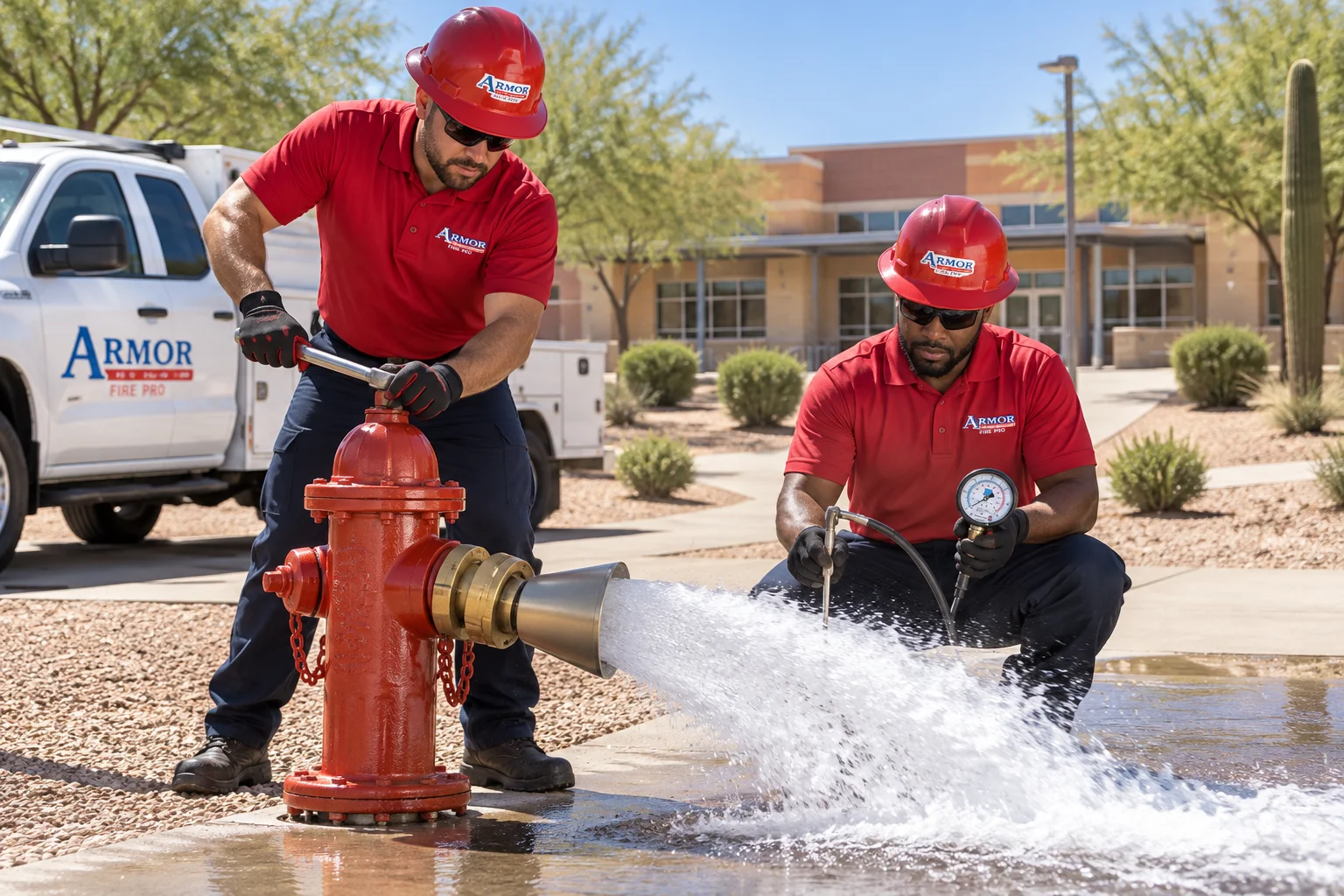
Fire hydrant flow testing measures how much water a private hydrant delivers and at what pressure, so a campus knows its fire water supply works before an emergency. Schools and municipal facilities that own their hydrants rely on fire hydrant services to test, flush and document every one.
By Armor Fire Pro Team, Fire Protection Specialists
Fire hydrant flow testing is a field measurement of the water a hydrant can deliver. A technician records static pressure (pressure with no water moving), opens a flow hydrant to discharge water, then records residual pressure (what remains in the main while water runs). Those readings show how many gallons per minute (gpm) the supply can sustain.
Campuses need it because many school and municipal sites own a private loop of underground pipe, valves and fire hydrants that the public utility does not maintain. These private water systems rarely get a second look until a fire or an inspection forces one. The same loop usually feeds the Fire Sprinklers inside each building, so a weak yard main weakens every sprinkler behind it.
NFPA 291 is the standard that sets the method for fire flow testing and hydrant marking. Hydrant flow testing against it gives the fire department a number to plan around and gives campus staff a dated record for inspectors and insurers. Phoenix-area water is hard, and mineral scale can bind valves on idle hydrants, so regular hydrant testing also proves the valves still move.
What is the fire hydrant flow test procedure, step by step?
The fire hydrant flow test procedure runs through six steps:
- Notification. The technician tells campus facilities staff, the fire code official and, if the campus ties into a public main, the water utility. Schools usually test during breaks or after hours because discharge is loud and muddy.
- Setup. The crew picks a test hydrant (the residual hydrant) and a flow hydrant downstream of it, mounts a pressure gauge on one outlet of the test hydrant and connects hoses or a diffuser to the flow hydrant so water runs to a drain, not onto landscaping.
- Static reading. The technician opens the test hydrant valve slowly, bleeds the air and records the static pressure.
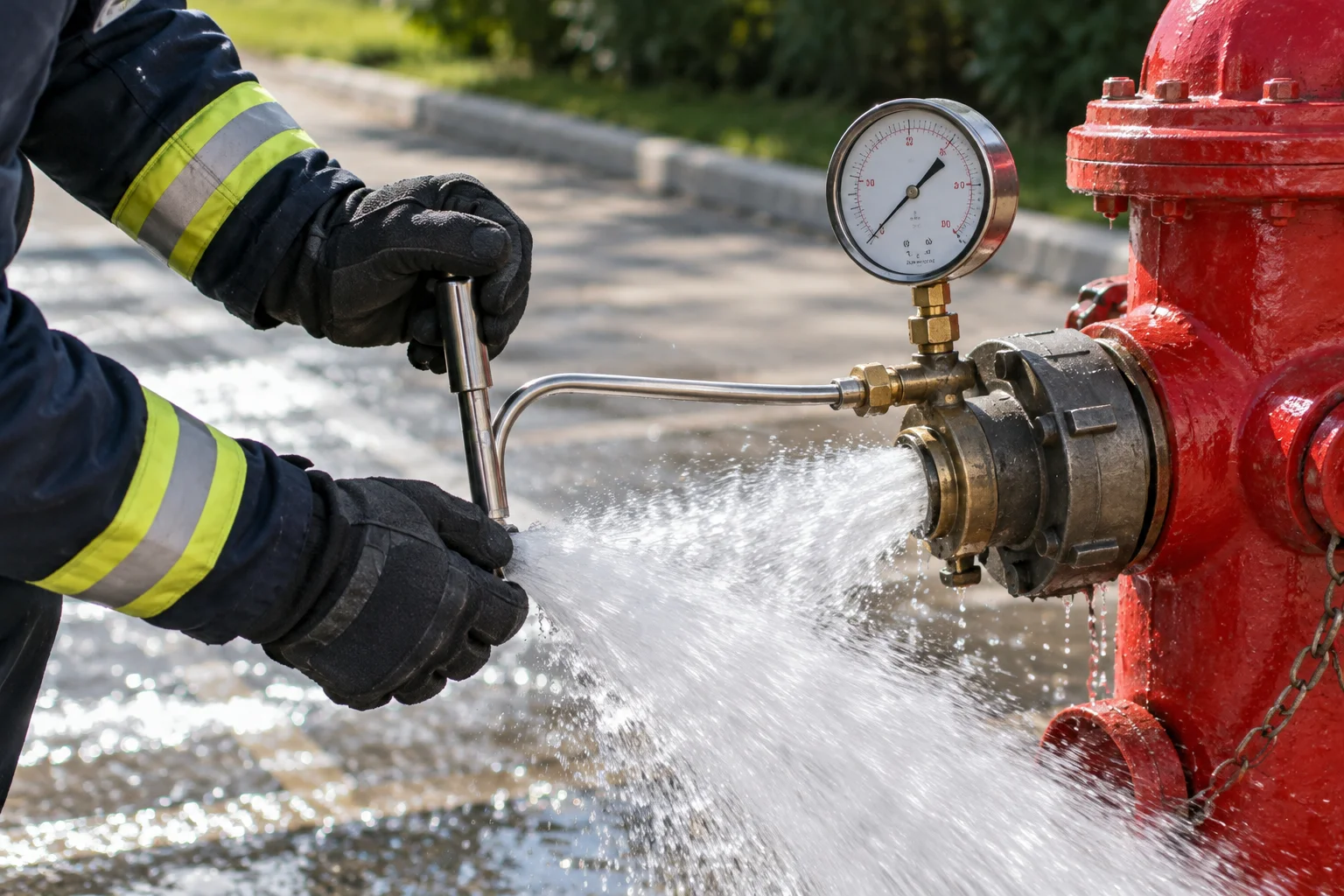
- Flow reading. The crew opens the flow hydrant outlet fully. Once the stream steadies, the technician holds a pitot tube (a small probe that reads the pressure of moving water) in the center of the stream, about half an outlet diameter from the opening, and records the pitot pressure. A second reading captures the residual pressure at the test hydrant at the same moment.
- Shut down. The crew closes the flow hydrant slowly to avoid water hammer (a pressure surge that can crack pipe), confirms the barrel drains and replaces the caps.
- Calculations and color coding. The technician converts the pitot reading to gpm, adjusts it to 20 psi residual pressure and assigns the hydrant its color class.
How do you calculate hydrant flow rate?
The flow rate in gpm equals 29.83 x c x d² x √p. Here c is the outlet coefficient (0.9 for a smooth, rounded outlet), d is the outlet diameter in inches and p is the pitot pressure in psi.
Example: a 2.5-inch outlet, a coefficient of 0.9 and 40 psi pitot pressure give about 1,061 gpm. To find the flow at 20 psi, multiply that by ((static minus 20) divided by (static minus residual)) raised to the 0.54 power. With 70 psi static and 55 psi residual, the result is about 2,030 gpm.
What are the fire hydrant pressure and flow requirements for a campus?
NFPA 291 does not set one required flow for every site. The target comes from each building's sprinkler system demand and the local fire code official, so confirm it before test day. What NFPA 291 does set is how hydrants are rated: by flow at 20 psi residual pressure, shown by the bonnet (top cap) color.
| Class | Bonnet color | Flow at 20 psi residual |
|---|---|---|
| AA | Light blue | 1,500 gpm or more |
| A | Green | 1,000 to 1,499 gpm |
| B | Orange | 500 to 999 gpm |
| C | Red | Under 500 gpm |
A Class A hydrant can still fall short for a large gym or auditorium, so compare the result with the demand of the biggest building on the loop.
What is a single hydrant flow test and when is it enough?
A single hydrant flow test uses one hydrant. The crew flows one outlet while a gauge on another outlet of the same hydrant reads static and residual pressure. It often suits a campus loop with only one or two hydrants, or a yearly check that nothing has changed. It is weaker for sizing a new sprinkler system, where the engineer usually wants a separate residual hydrant. The fire code official decides which version is acceptable.
How do you read a hydrant flow test chart?
A hydrant flow test chart plots pressure on the vertical axis against flow on a special scale (flow raised to the 1.85 power). The technician marks static pressure at zero flow, marks residual pressure at the tested flow and draws a line through both points. Reading across at 20 psi gives the available flow. If the line passes above a building's demand point, the supply meets that demand. If it falls below, the campus has a gap.
What should a fire hydrant flow test report include?
A fire hydrant flow test report should let a reviewer repeat the test and reach the same answer. It lists:
- Date, time and the professionals who ran the test
- Location and number of the test hydrant and the flow hydrant
- Static, residual and pitot pressures
- Outlet size and coefficient
- Flow in gpm at the test and calculated at 20 psi
- Hydrant class and color, plus the gauge calibration date
- Deficiencies, including any valve found closed
What maintenance do private fire hydrants on school and municipal campuses need?
Private hydrants fail from neglect more than from age. Yearly inspections should cover:
- Barrel, caps, chains and outlet threads, checked for damage and leaks
- About three feet of open space around each hydrant, so crews can fit hoses
- The main valve, operated through full travel and closed again
- Flushing until the discharge runs clear, which clears sediment and scale
- Lubricated stems and caps, and a barrel that drains
- A visible, correct bonnet color and hydrant number
Every hydrant also depends on the isolation valve on its branch line. A valve stuck half closed can pass a visual check and still choke the water flow in a real fire, which is why flow readings matter more than appearance.
How often is fire hydrant flow testing required for a private campus?
NFPA 25, the standard for inspecting, testing and maintaining water-based fire protection, calls for hydrants to be inspected at least yearly and after each use. It sets separate intervals for flow testing underground piping. Many fire code officials and insurers ask for hydrant flow testing every year, so treat annual as the working schedule and confirm it locally. Many campuses pair the hydrant visit with annual fire protection inspections for sprinklers and alarms. Retest after any repair, new building or sprinkler system change.
Who is qualified to perform fire hydrant flow testing?
Qualified professionals know the NFPA 291 method, carry calibrated gauges and pitot tubes, and can read results against building demand. Arizona and local jurisdictions may require licensed contractors for some of this work, so ask the fire code official what they accept. Armor Fire Pro provides fire hydrant services in Phoenix, Tempe, Gilbert, Mesa, Chandler and Scottsdale.
What happens if a private hydrant fails its flow test?
A failed hydrant test means readings fall below the target for the buildings served, or the hydrant will not operate. The usual path:
- Retest to rule out a gauge or valve-position error.
- Trace the loop valves, since a closed or partly closed valve is a common cause.
- Flush, clean and repair stuck or leaking hydrants.
- If the main is undersized or choked with rust buildup, the fix may be larger pipe, a looped connection or a booster fire pump that lifts pressure to building demand.
- Tag any out-of-service hydrant, tell the fire department and retest after repairs.
Frequently Asked Questions
What device is used to measure hydrant flow?
A pitot tube with a pressure gauge measures hydrant flow. The technician holds the tube in the center of the discharge stream and reads the pitot pressure. That reading, plus the outlet size and coefficient, converts to gpm. A second gauge on the test hydrant records static and residual pressure.
What is a fire sprinkler flow test?
A fire sprinkler flow test checks the water supply to a building's sprinkler system. Technicians flow water through the inspector's test valve to confirm the water flow alarm sounds. A hydrant flow test measures the yard supply instead.
Do private hydrants need flow testing if the city tests its water mains?
Usually yes. A utility's testing covers the public main, not the private pipe, valves and hydrants past the connection. On a campus, the owner is responsible for that private loop, and the fire code official or an insurer may ask for documented hydrant testing. Ask the local fire code official which tests and intervals they expect.
Schedule Fire Hydrant Flow Testing Before Your Next Inspection
Campuses in Phoenix, Tempe, Gilbert, Mesa, Chandler and Scottsdale can request a Free Quote for fire hydrant flow testing and hydrant maintenance.

